Three fourth-down stops serve as more evidence of the Longhorns’ defensive prowess
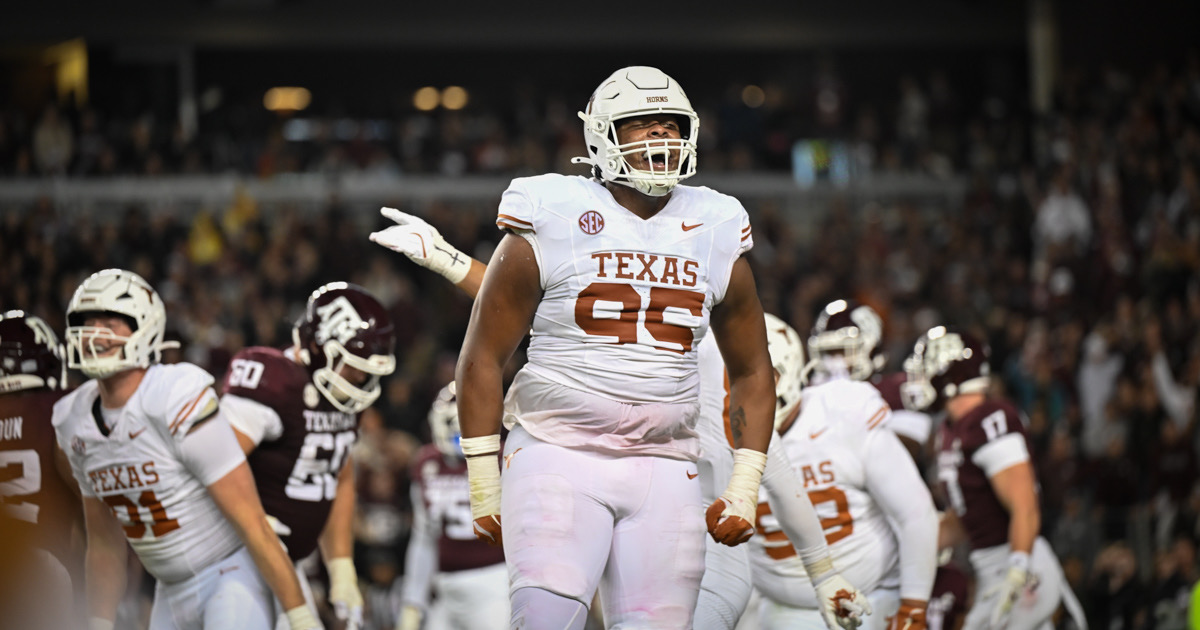
COLLEGE STATION — On their first offensive drive of the game, the Texas A&M Aggies drove deep into Texas territory but encountered a 4th and 1 on the Longhorns’ 10-yard line. The Aggies elected to hand the football off to Amari Daniels, but defensive tackle Jermayne Lole made the stop to turn the ball over on downs.
[Join Inside Texas TODAY and get ONE WEEK for just $1]
With seconds remaining in the first half and down 17-0, A&M again decided to go for it on 4th down, but Marcel Reed was tackled short of the line to gain at the Texas 43.
So late in the game, Aggies head coach Mike Elko had a choice with his team down 17-7 and under five minutes left on the clock. Should he try to make it a one possession game with the field goal and get a stop-and-score? Or should he test the Texas defense on fourth down once again from one yard away to try to capitalize on momentum from a blocked punt?
Elko chose the latter to try a salty Longhorn defense. A&M offensive coordinator Collin Klein called what Texas’ Anthony Hill identified as G-lead. Aggie players failed to block Ethan Burke, and Texas recorded a third fourth-down stop of the Aggies offense and in doing so, recorded the pivotal play that kept the A&M offense out of the end zone in the return of the Lone Star Showdown.
Texas won 17-7, and the Aggies’ seven points were the result of a Quinn Ewers tipped pick-six as opposed to points put on the Longhorn defense.
Those three stops were indicative of a strong day for Pete Kwiatkowski’s side of the ball as it continues to claim a status among the best in college football.
The Aggies tallied 244 yards and averaged only 4.3 yards per play.
While Texas A&M picked up some chunk plays via Reed’s arms and legs, consistency was tough to come by for the Aggies. Two of A&M’s three drives that were nine plays or longer ended in those turnovers on downs. The third? It ended in a punt.
The strong day wouldn’t have existed if it weren’t for Texas’ fourth down prowess in the red zone on Saturday night that kept A&M’s offense off the scoreboard. And that fourth down prowess is the direct result of a portion of Longhorns’ practice that emphasizes an aspect so simple yet so important in football.
“Don’t let them get in the end zone,” Texas defensive tackle Vernon Broughton said.
Texas head coach Steve Sarkisian explained following the game that his team has a portion of practice he calls red zone lockout. Sarkisian says it’s a good-on-good, sudden-change period where the ball is placed on the 25 and the defense is challenged to keep the offense out of the special 10 yards. The goal is simple for the offense: score.
The Longhorn defense is proficient at making that task complex.
“I think we developed a mentality in there that we are defending our end zone,” Sarkisian said. “It doesn’t matter if they are six inches away from that goal line, that’s one more snap that we can defend our end zone. Our guys have done that all year.”
When Elko decided to keep his offense on the field, Hill and company smiled. Thanks to the lockout practice, Hill felt like they were in a comfortable environment, or at least one they knew they could excel in.
“We were excited because we feel like nobody’s getting in the end zone with us,” Hill said when describing his thoughts ahead of A&M’s final fourth down attempt. “If you think you’re going to just run right at us for one yard, you’ve lost your mind. That’s not going to happen.”
Not much has happened against the Longhorns defense this year. Texas ranks No. 10 in stuffing opponents in the red zone, a stat that is one of many where the Longhorns rank among the best in the nation.
“Our goal and what we preach is defending our paint and defending our end zone,” Michael Taaffe said. “No matter what the opponent is, we don’t let anyone get in our end zone. That’s the pride we have about ourselves, and we work really hard throughout the week to make sure the standard is upheld.”
The work of players on the defensive front like Broughton and Alfred Collins often kept the Aggies behind schedule on offense. A&M averaged 2.9 yards per rush against Texas. The Aggies’ one rush of 10-plus yards was via a Reed scramble on a quality play design. No other run went further than 10 yards.
Anthony Hill Jr. (Will Gallagher/Inside Texas)
“Those guys, Alfred and Vernon, are really versatile players because of their length and their athleticism but both those guys have really worked at their craft to be very good run defenders for us, which was something we challenged them on all offseason,” Sarkisian said. “Then they have the ability to rush the passer because of their athleticism and their length.”
Then at linebacker, Hill and Liona Lefau led the way in tackles with five and six, respectively. Lefau also forced an early fumble A&M recovered.
And in the secondary, Taaffe recorded an early interception to lead a standout day for a group that allowed one pass of 20 or more yards.
The Longhorns succeeded at all three levels and continued to stake their claim to having the best defense in the country. It was an effort that was physical, and one that was dominant.
“To do it in the fashion that we did, that wasn’t a gimmick win,” Sarkisian said. “We didn’t hit trick plays and things. We lined up and played good, hard-nosed football, and executed. Couple balls didn’t bounce our way, but we won the game in a physical manner, which is what we knew we needed to do to win the Southeastern Conference.”
On Saturday, Texas had to defend 57 plays. Like a strong, top-tier defense does, the Longhorns were fantastic against an offense that has just one reliable method for moving the football.
[Subscribe to the Inside Texas YouTube channel!]
And no plays embodied that fantastic night in College Station like Texas’ three fourth-down stops that harkened back to key portions of practice sessions.
The post Three fourth-down stops serve as more evidence of the Longhorns’ defensive prowess appeared first on On3.