The Watch Begins: Alan Haller and Michigan State essentially begin coaching search, Saturday
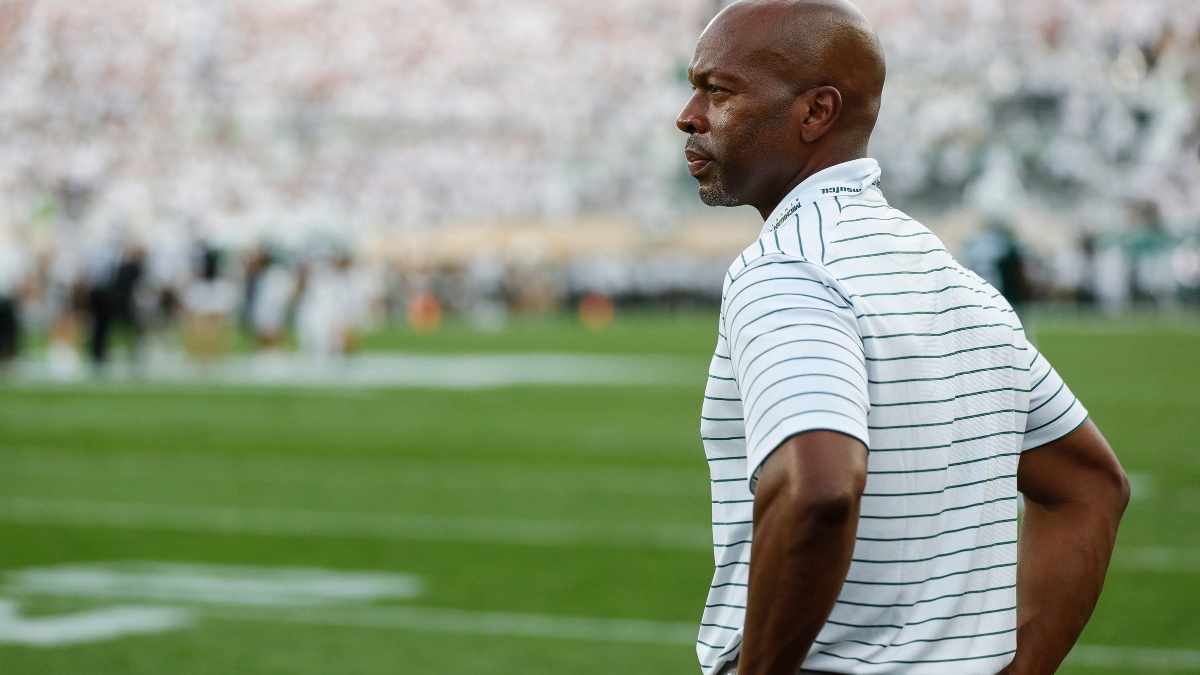
East Lansing, Mich. – Michigan State has a unique opportunity to spend 10 weeks sorting through a nation of candidates for its semi-open head football coaching job. The Spartans are 2-0 with Harlon Barnett working as the interim head coach, in the wake of Mel Tucker’s unpaid suspension.
Michigan State is removing Tucker photos and slogans from the football complex, a clear sign that the athletic department plans to move on without him in 2024. This article will refer to Tucker in the past tense.
Barnett’s 10 game stint as interim head coach will determine the merit of his candidacy. And make no mistake about it, he has a shot. We mean no disrespect to him and his opportunity while also scanning the road ahead for the possibility of other eventualities.
Athletic director Alan Haller will be watching Barnett, his long-time friend, colleague and fellow Spartan Dawg, closely through the remainder of the season, not only for wins and losses but sideline control, organizational skills and his overall command of the program in the next several weeks. If Michigan State beats Washington on Saturday, Barnett’s candidacy will gain enormous momentum.
Haller will be watching other candidates in the meantime. Many of those candidates might have an eye on Michigan State, too. What will they see? SpartanMag.com offers a self scout on Michigan State as a football program as it pertains to attracting a new head coach, while Barnett works to prove he is the man for the job.
THE OVERVIEW
Haller has 10-plus weeks to make contacts with, and receive contacts from, agents and representatives of various coaches across the country. Some representatives will approach Haller. In most cases, Haller will have to do the approaching. When does he begin doing that? What kind of reaction to Michigan State will he receive across the country? What kind of names will approach him. That information will remain quiet from Haller’s end. Whether or not information leaks at the other end of the tunnel remains to be seen.
HOW ATTRACTIVE IS MICHIGAN STATE?
TRADITION
Michigan State is a traditional Top 25 program in terms of all-time wins (No. 26) and all-time winning percentage (No. 23, discounting mid-major programs).
Michigan State has ranked No. 18 in the nation in average attendance over the last five years, with an average of 69,047 last season, operating at 92 percent capacity, according to collegefootballnews.com. Michigan State has been in or around the Top 20 in attendance for several decades.
FINANCIAL BACKING
Michigan State has competitive financial resources, thanks to Big Ten television contract money and a small handful of heavyweight donors.
Michigan State is a power when it comes to financial resources, but not a nuclear power. Michigan State was able to give Tucker a groundbreaking 10-year, $95 contract late in the 2021 season. Thanks in part to mega donors Matt Ishbia and Steve St. Andre, Michigan State was strong enough to produce that kind of cash in 2021.
Is Michigan State capable and willing of making that kind of financial commitment a habit? Does Michigan State want to give donors that kind of power again?
Other programs like Texas or Texas A&M are able to foot a bill like that without a sweat. At MSU, when Tucker was given that contract, there was sweat. Maybe not from Ishbia and St. Andre, but there were new board members and administrative wheels who were aghast at that contract. There was a lot of complaining behind the scenes. After all that complaining, what are the chances that Board members will be in favor of a huge-money contract created to lure a proven FBS-level head coach to East Lansing? It would necessitate some convincing.
And there’s also the possibility that Tucker will command a sizable settlement. There are always settlements. MSU will essentially be paying two coaches at once, at least for a little while. That will put a dent in Michigan State’s ability to woo a high-figure candidate.
FACILITIES
Michigan State is in the process of finishing the $78 million, 65,000 square foot Tom Izzo Football Building. It will be one of the finest football building in the country, and in some ways maybe the best.
It is being finished at a time when pumping obscene amounts of money into facilities is likely coming to an end. Donations that used to fuel facility upgrades will now feed NIL collectives.
Is it good for MSU that the facilities arms race is likely coming to an end? Considering MSU seems to have batted last in this facilities game, that’s probably a good thing for the Spartans. Which programs are going to come along and outshine MSU’s football facility in the coming years? Not many, if any. That money is headed for NIL. So MSU’s facility could loom as a shining star for years to come.
NAME, IMAGE & LIKENESS
Michigan State has been slow out of the gates when it comes to NIL – effective in some regards, but suffering slippage in others. Michigan State took a constructive step forward on Thursday in announcing that Spartan Dawgs For Life (SD4L) is now the official NIL partner for Michigan State athletics. Prior to that, MSU donors weren’t sure where to put their money if they wanted to support an NIL collective. Another Michigan State NIL collective, This Is Sparta, has signed large deals with a few Spartan football players, and dozens of MSU Olympic sports athletes. This Is Sparta is as a non-profit organization.
Michigan State is offering slick premiums to SD4L donors. At some point, donors are going to want Spartan Fund points in order to give to SD4L. Currently, donations to neither NIL collective result in Spartan Fund points for donors.
Tucker complained about the Spartans’ NIL structure in an interview with the Lansing State Journal three weeks ago. Some boosters who have given large sums of money were angered by his words. But those words will resonate with prospective coaching candidates. They will want to know the truth about Michigan State’s NIL structure. That will be up to Haller to demonstrate that MSU is ready and able to move forward in this space.
RECRUITING BASE
Michigan State’s recruiting base is not top tier (as is the case for schools in the Florida/Georgia/Alabama/Louisiana sun belt). It’s not second tier (like Texas and California). It’s third tier. It’s not bad.
Mark Dantonio leaned on terrific evaluation skills and player development with Ohio and Michigan as ground zero on his recruiting radar. That area, and the border states, provided a workable base. Supplement that with well-placed doses of recruits from Georgia, Florida, New Jersey, the mid-Atlantic region and anywhere else football players come from, and the formula can work without a ton of four-star recruits from outside the Midwest – if evaluation and player development are impeccable.
History has shown Michigan State has a better chance to get four-star type recruits from Ohio and Michigan than regions outside the 6-hour radius. That has the capacity to change if MSU can become a strong in NIL and establish itself as a winner in the fall. But history indicates Michigan State needs to start local for four-stars, and branch out for underrated three-stars further away from home. Chasing the occasional four-star in Georgia or Florida might result in a recruiting win or two. Tucker tried to prove that he could win more than that. But his early flurry began to lose steam in recent months. The 5-7 season and NIL bobbles had something to do with that.
In Michigan, Dantonio eventually was able to match and exceed Michigan for top in-state talent, for a short period of time. Sign half of the top dozen or so players in Michigan every year? That’s do-able, regardless of how strong the Wolvereines are. Get in early, work hard, bring in-state recruits to campus, woo them with personality and culture. Dantonio and his staff weren’t perfect at all of those things, but good enough to build a base.
Michigan State must hit Ohio hard. Any time MSU has had Top 10 teams, Ohio talent has been a huge factor on the roster. Tucker didn’t de-emphasize Ohio recruiting per se, but he didn’t put Ohio at the top of the pyramid like Dantonio did.
Tucker instituted a recruiting model which called for assistant coaches to recruit their own position from coast to coast. Sometimes that brought a Michigan State assistant coach or two to a specific town or two in Ohio. But Michigan State didn’t carpet bomb the state with assistant coaches the way it did in the Dantonio era.
Dantonio gave every coach on his staff an area of Michigan and an area of Ohio.
In the last few months, Tucker began spending more time recruiting Ohio players than in his first three years. Michigan State needs to treat Ohio like a suburb of Detroit and scour the place.
Over the last 30 years, since I’ve been studying recruiting in this region, I’ve noticed that middleweight programs which rise to become the No. 2 recruiter in the state of Ohio always land in the Top 20 in on-the-field success, whether it’s been West Virginia in some glory years, Boston College for a short period of time under Tom O’Brien, Michigan State under Dantonio, or Kentucky with Mark Stoops, or Cincinnati with Luke Fickell. Even Glen Mason dipped his toes in the Top 20 at Minnesota when the Gophers were No. 2 in recruiting in Ohio.
Ohio is a critical resource for Michigan State. Experts say the talent base in Ohio has been on a downturn. That may be true. But Ohio still ranks among the top five states in putting players on NFL rosters, as of last season.
Michigan State isn’t getting any players out of Lake Superior, Lake Huron or Lake Michigan. The Spartans have to go south to recruit. On their way to Georgia and Florida, MSU must turn over every rock in Ohio, and develop a great network of help from high school coaches in Ohio, like Dantonio did. Mrs. Kelce would recommend it.
Doing well in Michigan and Ohio only sets the foundation. From there, Michigan State must try to add talent from all the other far-reaching places where players reside, especially in Georgia. Everyone recruits in Georgia. It’s a zoo down there. Tucker, who had great ties in The Peach State, set out to use Georgia as a cornerstone for his roster. He did well there, for a non-Top 10 program, 800 miles away. Maybe not as well, consistently, as he hoped and expected, considering he was recently defensive coordinator of the Georgia Bulldogs and ranked among the best recruiting assistants in the country in 2018.
Tucker began to realize in the past 18 months that MSU might have the ability to attract great amounts of talent to Michigan State for official visits, but beating out top bidders in the South to gain commitments on signing day proved difficult. He won recruiting battles when he wore Alabama and Georgia shirts to those homes as an assistant at those schools, with all the financial support and glory that they offered. As a Michigan State coach, he gained an audience with big-time talent in the South, and they liked him, but he found it hard to close deals.
A good salesperson with a sparkling personality, Tucker was an ambitious and energetic recruiter. However, unless Michigan State became a terror in NIL, Tucker and his staff weren’t going to land Top 10 classes.
He began to realize that he needed to put together a string of Top 10 seasons on the field before having a chance to land Top 10 recruiting classes. In the process, his program needed to match or approach the NIL packages that other schools were offering. And then if most things were equal, the traditional factors like official visits, the beauty of campus, and the attempts to create a family atmosphere within the program, might allow Michigan State to compete with some sun belt powers for a few high four star recruits. But it turned out to be a steeper climb than he expected when he said the day he was hired, “If you can’t recruit at Michigan State, you can’t recruit.”
A Top 10 season in 2021 and staff diligence was enough to attract official visits from 26 four star (blue chip) recruits in the summer and fall of 2022, easily the most of the 85-scholarship era for Michigan State. However, the Spartans struggled to a 5-7 season that fall and ended up signing only eight four-star recruits, nabbing a No. 21-ranked recruiting class. That’s a good class, a very good class by Michigan State standards, but not as strong as Tucker and then-general manager Saeed Khalif expected, coming off a Top 10 season and a huge summer of visits.
Tucker began recalibrating his recruiting approach for the 2024 class, putting more emphasis on evaluation of three-star recruits. He won’t get the chance to see that part of the process through, but it seemed to reaffirm the way it needs to be done at Michigan State when trying to build a Top 25 team, and then a Top 20 team and so on.
As for Tucker’s experimentation with positional recruiting rather than regional recruiting, I spoke with a colleague who covers Alabama and he said Tucker didn’t adopt that approach from Nick Saban or Kirby Smart. The Alabama writer confirmed that Saban still recruits the way he did at Michigan State – giving each assistant coach local, regional and national areas to recruit.
Tucker did a lot of experimenting. He tried to recruit to Michigan State in a way that had never been attempted. It was a noble, ambitious undertaking, and worth a shot. But he didn’t have all the elements needed to really go elephant hunting the way he envisioned. If he had put together a string of Top 10 seasons, and had great NIL support, it would have been interesting to see how well he and his staff could have done.
But in the meantime, elements of the Dantonio way were seeping back into the program, and for good, practical reason.
Tucker’s philosophy of positional recruiting might have been good in giving assistant coaches autonomy, responsibility and pressure to go from coast-to-coast to fill their respective position rooms. But it curtailed Michigan State’s chances of networking with high school coaches and hearing about a LeVeon Bell or a Kurtis Drummond or a Darqueze Dennard who might be falling through the cracks.
“I like the area way, personally,” Barnett said during the Michigan State coaches radio show on Thursday, “because you get a chance to know the coaches in that area. You get a chance to not only know them, you know their players and their upcoming players.
“They’ll tell you, ‘Hey, I have a freshman, keep an eye on him.’ Then you come back next year and he’s a sophomore. ‘How’s that kid doing?’ And then you start building a relationship that way.
“The coaches know you well. You get to build a relationship and they get to know you. They knew when Michigan State was going to come into the school, it’s Harlon Barnett, or it’s whoever. They’ll tell you things sometimes that they won’t tell everybody else because you’ve built that relationship and that trust.”
Michigan State fans can dream about Top 10 classes with more than a dozen four star recruits each year. That’s not impossible. But it will take many incremental steps to get there. In the meantime, evaluation and player development are still the main ingredients to get the engine purring.
Until proven otherwise, Michigan State is still a “developmental” program. The next head coach will need to circle back and make the best of all recruiting streams, including the networking piece on a local and regional basis, build from there, and maybe after years of success, and strong NIL backing, Michigan State could become more than a developmental program. It will take an exceptional coach with a great staff and far-reaching support to get those boxes checked.
OTHER CHALLENGES
Some coaching candidates may see Michigan State as a football hotrod. But MSU is mired in a pack of top fuel dragsters: Michigan and Penn State are likely to be on the Spartans’ menu every year when the Big Ten’s new schedule system is released, with Ohio State a frequent opponent, and USC, UCLA, Washington and Oregon headed to join Iowa, Wisconsin and the rest.
Some have suggested the Kansas State head coach Chris Klieman would be a good candidate for the Michigan State job. And he would be … a great one. Let’s use him for an example. He’s making $4.5 million per year at K-State. What would it take for him to consider leaving Kansas State and going to Michigan State? $7 million per year, or more, and a longer contract? Coming off the Tucker boondoggle, would Michigan State administrators be behind that?
From there, why would Klieman want to tussle with Michigan, Penn State, Ohio State, USC and the other schools mentioned above when he can stay in the Big 12 and wrestle down a weight class with Oklahoma State, Colorado, TCU, Kansas and still have access to the future 12-team College Football Playoff? In theory, he might have better resources, support and access to players at Michigan State than at Kansas State, but an easier path to the Playoff could trump those factors.
Michigan State is attractive. But there are limits to the attraction.
LESSONS AND POTHOLES
There are lessons from Michigan State’s successful and unsuccessful coaching searches of the recent past. Among them:
Don’t wait too long to start working on a list. Ron Mason fired Bobby Williams on Nov. 4, 2002. He didn’t hire a replacement until six and a half weeks later when John L. Smith was introduced on Dec. 19. That was a ridiculous delay.
In the meantime, Board of Trustees member Joel Ferguson, who didn’t get along with Mason, flew Marvin Lewis into East Lansing. Lewis was defensive coordinator of the Washington NFL team at the time. Ferguson prepared a contract for Lewis. If Lewis had signed it, Ferguson would have presented him to the Michigan State Board of Trustees and there might have been an intriguing decision as to whether to take a vote on Ferguson’s candidate or wait to see who Mason produced. Lewis gained a sense for the political whirlwind, dropped out of the running and became head coach of the Cincinnati Bengals the following year. He coached the Bengals for 15 years and won a Super Bowl.
Hired in late December of 2022, Smith had no chance to put together a good recruiting class that year, and there was little evidence that Mason did much to sort through candidates during all of that lost time.
Haller has been involved in two coaching searches in the past. He won’t repeat Mason’s mistake.
Utilize Tom Izzo. Michigan State didn’t tap into Izzo’s knowledge and networking power during the 2002 search which yielded Smith. Mason was still the athletic director when Smith was fired in 2006, but Mason wasn’t entrusted to handle the search for Smith’s successor. Mark Hollis, then an assistant athletic director to Mason, spearheaded the 2006 search.
Hollis tabbed his long-time friend Izzo, and Haller, in reviewing and interviewing candidates, which included Central Michigan head coach Brian Kelly (now head coach at LSU), Cleveland Browns defensive coordinator Todd Grantham (now defensive line coach of the New Orleans Saints), Florida defensive coordinator Charlie Strong (now an analyst at Alabama) and Dantonio.
Ferguson pushed for Miami Dolphins wide receivers coach Charlie Baggett, a former Spartan assistant coach and quarterback. Ferguson aggressively lobbied Michigan State president Lou Anna Simon on Baggett’s behalf. Simon listened, but she was more interested in speaking with Baggett’s boss, Saban, to make sure he didn’t want to come back to Michigan State. Saban said no, and soon wound up at Alabama. Meanwhile Dantonio got the job at Michigan State, with Izzo having had a major hand in it.
After Dantonio retired, former Michigan State athletic director Bill Beekman barely consulted with Izzo. Beekman hired an outside firm, DHR Global, led by managing partner and Michigan State graduate Glenn Sugiyama, to lead the search. That search yielded Fickell as the top candidate.
Sources tell SpartanMag.com that Fickell was inches from being hired, but last-minute holdups with Michigan State’s Board of Trustees caused a delay, and led to Fickell backing out. Could Izzo have helped usher that thing through? We’ll never know.
Michigan State circled back to Tucker, whom Sugiyama’s group had interviewed earlier in the process. Michigan State forked over a huge offer to Tucker to salvage the search.
Penn State defensive coordinator Brent Pry (now head coach at Virginia Tech), San Francisco 49ers defensive coordinator Robert Saleh (now New York Jets head coach), and Pittsburgh head coach Pat Narduzzi were also of interest. When Narduzzi realized early in the process that he wasn’t the lead candidate, he opted out, and stayed out when Michigan State went into scramble mode. SpartanMag was unable to confirm rumors that Ferguson was pushing for New England Patriots defensive line coach Brett Bielema (now head coach at Illinois).
The upcoming decision to find Tucker’s successor will run concurrent with Michigan State’s search for a new university president. On Wednesday, Board of Trustees member Dennis Denno, chair of the presidential search committee, told The State News, Michigan State’s student newspaper, that the Board hopes to make a final choice for a new president by Thanksgiving.
If Barnett doesn’t have a strong season, and a coaching search commences, there will be candidates who will be attracted to Michigan State’s history, resources and potential. There will be candidates who will be turned off by the political reputation at Michigan State. Others might be reluctant due to unknowns regarding the presidency, and unfinished business on the Tucker front.
FINAL WORD
There will be some who will want the Michigan State job, sight-unseen. Urban Meyer was in that category in 2002 when he was head coach at Bowling Green, the year Williams was fired and Smith was hired. By 2006, when Smith was fired at Michigan State, Meyer was head coach at Florida and out of Michigan State’s league. But Izzo called up Meyer to ask him about Strong. During the conversation, Meyer told Izzo that he would have walked from Bowling Green to East Lansing to take the job in 2002, but Mason never called. Instead, Smith took the job without ever having stepped on campus. Michigan State had appeal then, and it does today as well.
As for this year’s potential search, and the navigation of potholes, chief among those ruts will be Michigan State’s infamous Board of Trustees. Board members need to stand back, resist grandstanding, let Haller do his job, vote when presented with a candidate, work hard, keep their mouths shut, and maybe good things will happen.
The post The Watch Begins: Alan Haller and Michigan State essentially begin coaching search, Saturday appeared first on On3.