On paper: Who has the edge in every facet of Notre Dame vs. USC?
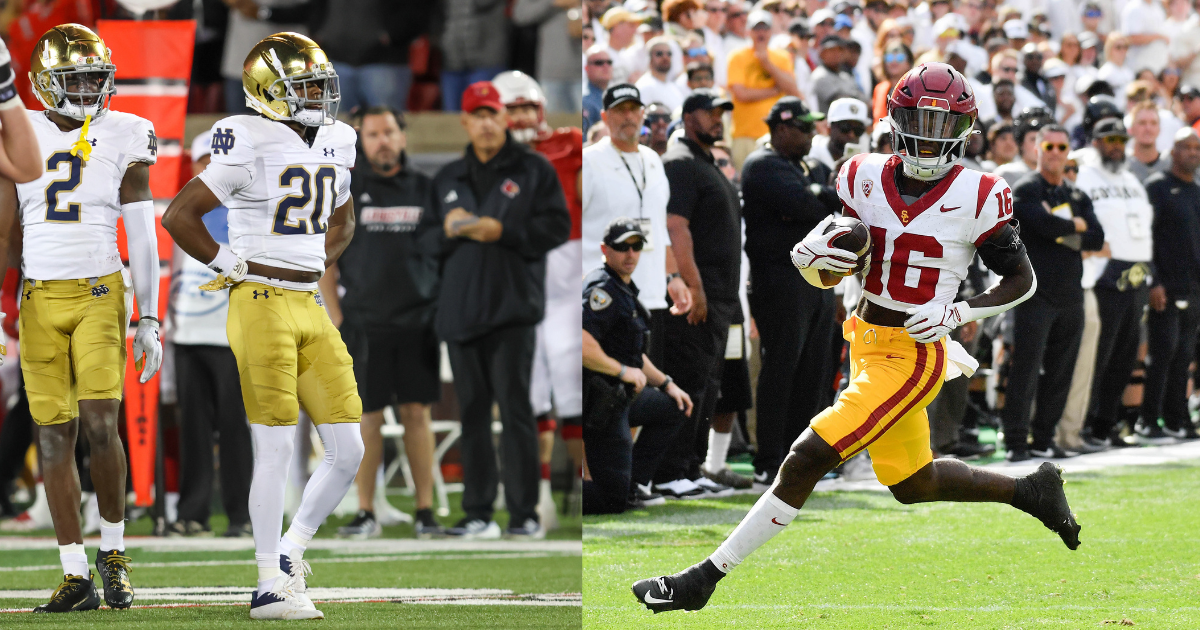
While its first six games haven’t been perfect, USC — Notre Dame’s historical rival and Week 7 opponent — is still a top-three contender for the Pac-12 championship in the final year of the conference as we know it. The Trojans also match up well against the Irish in a few key ways.
Here’s a complete breakdown of Notre Dame vs. USC on paper.
This story first appeared in the latest edition of Blue & Gold Illustrated. All statistics are accurate through Week 6.
USC Running Game vs. Notre Dame Run Defense
Notre Dame features a respectable run defense (No. 44 in the country) with 3.5 yards per rush allowed, but USC is a different animal. Redshirt junior running back MarShawn Lloyd, a transfer from South Carolina, had the highest Pro Football Focus rushing grade in the country (minimum 50 attempts) through Week 5 at 91.5. His elusiveness rating, which measures how difficult a running back is to tackle, was third-best in the nation at 203.4. Entering Week 6, Lloyd averaged 8.3 yards per carry on 52 attempts, leading USC to the fourth-highest rushing average in the country at 6.3.
It’s not just Lloyd, though. True freshman Quinten Joyner had 8.1 yards per carry on 14 attempts, while redshirt senior and incumbent starter Austin Jones entered Week 6 with a 7.4 average per carry. There’s also junior quarterback Caleb Williams, and Notre Dame should remember from last season how dangerous a runner he can be when he needs to be.
Tackling has been a concern for Notre Dame since Week 3 against Central Michigan, and the Irish threw up a massive red flag in Week 5 against Duke with a combined 16 missed tackles in Durham, N.C. Week 6 against Louisville offered two warning signs in the form of explosive touchdown runs from redshirt junior Cardinals running back Jawhar Jordan. While he represents the run defense’s strength right now, graduate student defensive tackle Howard Cross III tied graduate linebacker JD Bertrand for the team lead with 3 missed stops. Sophomore cornerback Benjamin Morrison and senior safety Xavier Watts had one apiece.
That can’t happen against the Trojans.
Advantage: USC
USC Passing Game vs. Notre Dame Pass Defense
Well, for Notre Dame fans hoping Williams would regress after his Heisman Trophy-winning sophomore season, I have bad news. Williams leads the nation in yards per passing attempt (minimum 100 throws) through Week 5. Despite holding a three-touchdown lead in the third quarter or earlier in four out of its five games this season, USC is fourth in the FBS in passing yards per game with 382.4.
The key to beating Notre Dame, which features an elite (No. 9 in opponent yards per attempt) pass defense led by star cornerbacks Morrison and graduate student Cam Hart, is bombarding the slot. Graduate student nickel cornerback Thomas Harper is a really good player, and he put up a fight against Ohio State star Emeka Egbuka, but he can’t shut down a great pass catcher one-on-one like Hart or Morrison can.
Leading USC wide receiver Tahj Washington, who has 18 catches for 395 yards (21.9 yards per completion) this season, operates almost exclusively out of the slot. Because USC head coach Lincoln Riley operates a spread offense — not the air raid, because the Trojans still run the ball a ton, but they spread it out — productive complementary wideouts Mario Williams and Zachariah Branch do the vast majority of their work in the slot as well.
The Trojans are as bad a matchup for the Irish pass defense as a team can be.
Advantage: USC
Notre Dame Running Game vs. USC Run Defense
The Notre Dame run game struggled against Duke and scuffled even more against Louisville, but the Irish are the 15th-best team in the nation in yards per carry at 5.5. They use a committee backfield led by Audric Estimé, who owns the No. 3 PFF offense grade in college football (minimum 50 attempts) at 90.3. His elusiveness rating is a bit behind Lloyd’s but still an elite 163.9. The Irish will stick with the run game, too. Even as Estimé and the rest of the team scuffled against the Blue Devils, they kept at it and eventually he broke one for 30 yards and the game-winning touchdown.
Notre Dame knows what it wants its identity to be. It won’t shy away from taking deep shots or scoring a lot of points, but everything it does stems from a multi-dimensional run game with Estimé at its center.
USC’s run defense has improved from last season, jumping from 4.7 yards per carry against to 4.0, but 1) the Trojans have not faced a good rushing team yet, and 2) that 4.0 mark is still in the bottom half of the country. Like most Riley-led teams, USC struggles with tackling, missing 59 through five games this season. Notre Dame had 60 misses but through one additional matchup.
The Irish should run the ball well against the Trojans. If they can’t, that spells trouble.
Advantage: Notre Dame
Notre Dame Passing Game vs. USC Pass Defense
USC’s pass defense allows a middling 7.0 yards per attempt, but let’s look at the one game they’ve played against a passing game comparable to Notre Dame’s. Colorado quarterback Shedeur Sanders threw 45 times for 371 yards (8.2 yards per attempt) with 4 touchdowns and 1 interception. That doesn’t look good, but what looks worse is the lack of interceptions.
Through five games, USC has picked off 3 passes, which puts the Trojans on pace for 7.2 picks this season. They had 19 last year, which ranked second in college football behind Illinois. The one saving grace of an abysmal USC pass defense last season (24th-worst in FBS) was its ability to create turnovers. If that’s gone, the Trojans will struggle against the likes of Oregon, Washington, Utah (if star quarterback Cam Rising is healthy) and, yes, Notre Dame.
USC’s saving grace in the secondary is star safety Calen Bullock, who has an 88.8 PFF coverage grade this season. But he alone isn’t enough.
The Irish were the 16th-most efficient passing offense in the nation entering Week 6, led by graduate student quarterback Sam Hartman. This is despite facing the No. 5 (Duke) and No. 8 (Ohio State) pass defenses in the country in consecutive weeks. If Notre Dame wins this game, it might have to be in a shootout. Are Hartman and company up to the challenge?
Last week’s game against Louisville would indicate no. But Irish fans have to hold out hope that they can.
Advantage: Notre Dame
Special Teams
Incredibly, USC redshirt sophomore kicker Denis Lynch — who was recently put on scholarship — has attempted only 4 field goals in the Trojans’ first five games. Riley and Williams do not settle for field goals very often. He’s made 3 of them, which gives him a better percentage than Notre Dame graduate kicker Spencer Shrader, who is 5 of 10 this season. Their season-long kicks are similar, with Shrader at 54 and Lynch at 53. Lynch went 15 of 22 (68.1 percent) last season, which is better than Shrader’s career percentage of 64.7. Advantage USC in the kicking game.
Notre Dame sophomore punter Bryce McFerson has a better yards per punt average than USC junior Eddie Czaplicki, but it’s only by two yards and Czaplicki actually has a slightly better net punting average. Ironically, Notre Dame has the three highest-graded special teamers on either team in graduate student running back/return man Devyn Ford (who grades well despite his Week 1 fumble) at 86.0, junior defensive tackle Jason Onye and graduate student safety DJ Brown, who plays the most out of the three.
That said, I buried the lead here a little bit. USC wins this category by far, thanks to the Branch. He has to be seen to be believed, because no true freshman should be as good as he is. Branch has both the ability to accelerate from a jog to his top speed in an instant, and he has the wherewithal to go slow and set up blocks before taking off as a kick returner. As a punt returner, Branch is decisive — he doesn’t dance around; he puts a foot in the ground and goes.
Those are the skills that made three-time All-Pro Devin Hester so good at returning kicks. Hester was faster than Branch is, but it’s impossible to watch the USC freshman and not think about the Chicago Bears great. Branch averages 29.0 yards per kickoff return and 22.0 yards per punt return, and he’s scored twice. Notre Dame’s return units don’t come close to those numbers.
Advantage: USC
Coaching
If Riley woke up tomorrow morning and decided he wanted an NFL head coaching job, he likely would have one in seconds. Every offensive-minded coach claims to be a quarterback whisperer, but Riley has the track record of coaching three different quarterbacks to the Heisman Trophy. Williams was a top-ranked recruit and was successful right away, but Riley’s coaching jobs with Baker Mayfield and Kyler Murray stand out.
Mayfield was a walk-on at Texas Tech and later walked on at Oklahoma, where Riley took over as the offensive coordinator a year later. In Mayfield’s first year under Riley, he finished fourth in Heisman Trophy voting. Three years later, he became the No. 1 overall pick in the 2018 NFL Draft.
While Mayfield was winning games in his final two seasons, former top recruit and Texas A&M castoff Murray developed behind him. Murray took over at Oklahoma in 2018, which was supposed to be his final season as a football player since the Oakland Athletics made him the No. 9 pick of the MLB Draft in 2018. He played so well that season that he switched his career path back to football and was also drafted No. 1 overall the following spring. Williams, in all likelihood, will be the third Riley-coached signal-caller to become the top NFL Draft selection.
Oh, and he also has a good case to be the best offensive play-designer in the country.
On the Notre Dame side, Irish fans are still upset at second-year head coach Marcus Freeman and his staff for failing to put an 11th player on the field for the biggest two plays of the season against Ohio State. They now equally upset with offensive coordinator Gerad Parker, with the game plan against Duke relying a little too heavily on Estimé up the middle and everything going wrong against Louisville. USC has the edge here.
Advantage: USC
Intangibles
One could forgive Notre Dame for being tired entering this game. The Irish will be playing their eighth straight game and fourth straight night game. Despite doing everything they possibly can to keep their players rested and fresh for the stretch run, that could very well be a factor in Saturday night’s game.
Like Notre Dame, USC played in Week 0 (a 56-28 home win over San Jose State). But unlike Notre Dame, USC had its bye week in Week 3 (Sept. 16). The Trojans won’t be as burnt out as the Irish will, and that’s not about the quantity of games played — it’s the quality. Notre Dame is finishing a brutal stretch of four ranked, undefeated teams in Ohio State, Duke, Louisville and USC. The Trojans’ first six games were against San Jose State, Nevada, Stanford, Arizona State, Colorado and Arizona, none of whom were ranked when they played USC or at the time of this writing.
The Trojans had this game circled on its calendar as “this is where the season begins,” so they’ll come out firing. Will Notre Dame? The players — graduate student linebacker Marist Liufau outright said it — understand the rivalry and are upset about what happened last season.
Notre Dame is at home, which helps, but the rest factor gives USC a slight edge. And that might be all it needs.
Advantage: USC
The post On paper: Who has the edge in every facet of Notre Dame vs. USC? appeared first on On3.