Coach Watch: Can Michigan State make a ‘Top 25 Program’ hire? Let’s delve into what that means
East Lansing, Mich. – The Spartans technically do not have a coaching vacancy with Harlon Barnett in place as the interim head football coach, but that shouldn’t stop Michigan State from gazing around the country to see what kind of coaching talent will be available if and when a full-blown coaching search begins.
Meanwhile, talk show hosts and pundits view the pool of coaching talent from an arm chair and put forth arguments that Michigan State “is a Top 25 program in America, and therefore it should hire a head football coach befitting of a Top 25 program.”
Okay, let’s delve into that, define some terms and take a look at where Michigan State’s peer programs on the fringe of the Top 25, and sub-peer programs, have gone to find head coaches. It may give us a sensible, rational, realistic viewpoint of the coach-hiring landscape.
MICHIGAN STATE A TOP 20 PROGRAM? ALMOST
Michigan State is not quite one of the Top 20 programs in the country, by whatever metric you want to use, whether it’s tradition, historical success, fan support, financial resources, recruiting base and recruiting resources. Michigan State is close, but just outside of the Top 20.
Michigan State is strong in the areas mentioned above, but using a subjective, unscientific combination of all of those categories, Michigan State isn’t quite Ohio State, Alabama, Notre Dame, Michigan, Texas, Oklahoma, Penn State, Georgia, USC, Tennessee, Florida, LSU, Miami, Florida State and maybe one or two others depending on the decade.
Put Auburn on the list. The Tigers are No. 13 in all-time wins, rank among the Top 15 in attendance and would have hired Charles Manson as head coach if they thought he would beat Alabama and win some Sugar Bowls. They’re committed.
Texas A&M is perpetually a sleeping giant, but the Aggies’ resources, and blank check desperation, puts them in a higher echelon, deep into “Top 20 program” status, even if the results have yet to follow.
Add Clemson and Oregon to the list, above Michigan State, and probably UCLA, if the Bruins ever decide to commit to their football enterprise.
Oregon has never quite reached superpower status, but they’re funded like one, which makes the Ducks difficult to categorize. Add Big Ten clout and Oregon just gained horsepower.
Nebraska is an historic superpower, and retains potential, but has slid to the Iowa/Wisconsin/MSU category in the past two decades.
But let’s include Nebraska on the list, to give us a nice even 20.
In terms of my subjective read on the categories listed above, there are about 10 programs ranking outside of my Top 20, that have reason to believe they are “Top 25 programs.”
The list of second tier programs: Michigan State, Arkansas, Wisconsin, North Carolina, Missouri, Ole Miss, South Carolina, Iowa. That’s a total of only 28. So pick one or two programs out of the third tier, depending on who has had a good decade, and throw them in the Top 30 if you wish.
RELATED – Coach Watch: Duke’s Mike Elko heads list of candidates on the rise
You can argue with me about the rankings, but hold those arguments. Ranking these programs isn’t the point of this exercise.
Let’s drop down and look at the next tier for a moment, and where those third tier programs went to hire their current head coaches.
INSIDE THE THIRD TIER
The third tier is basically every Power Five school that’s not listed in my top 28 above.
In this list, I didn’t include the names of the coaches. This way, you can focus on where those programs went to hire their coaches, each coach’s previous position, and each coach’s age at the time of the hiring.
You will see few programs hired proven head coaches. Most of them hired assistant coaches.
Arizona: Hired the New England Patriots’ QB coach, 45, in 2021.
Arizona State: Hired Oregon’s offensive coordinator, 33, in 2023.
Baylor: Hired LSU’s defensive coordinator, 42, in 2020.
Boston College: Hired Ohio State’s co-defensive coordinator, 40, in 2020.
BYU: Hired Oregon State’s defensive coordinator, 40, in 2016.
California: Hired Wisconsin’s defensive coordinator, 39, in 2017.
Colorado: Hired Jackson State’s head coach, 56, in 2023.
Duke: Hired Texas A&M defensive coordinator, 45, in 2022.
Georgia Tech: Was promoted from interim head coach and offensive line coach, 44, in 2022.
Illinois: Hired New York Giants linebackers coach (former Wisconsin and Arkansas head coach), 51, in 2021
Indiana: Hired South Florida’s defensive coordinator, 47, in 2016.
Iowa State: Hired Toledo’s head coach, 35, in 2016.
Kansas: Hired University of Buffalo head coach, 57, in 2021.
Kansas State: Hired North Dakota State’s head coach, 51, in 2019.
Louisville: Hired Purdue head coach, 53, 2023.
Maryland: Hired Alabama’s offensive coordinator (former New Mexico head coach), 48, in 2019.
Minnesota: Hired Western Michigan’s head coach, 35, in 2017.
Mississippi State: Promoted defensive coordinator from within, 37, in 2022.
NC State: Hired Northern Illinois’ head coach, 40, in 2013.
Oregon State: Hired University of Washington offensive coordinator, 38, in 2018.
Pitt: Hired Michigan State defensive coordinator, 48, in 2014.
Purdue: Hired Illinois defensive coordinator, 37, in 2023.
Rutgers: Hired former Rutgers head coach, and head coach of the Tampa Bay Buccaneers, who hadn’t coached for two seasons, after most recently spending two years as defensive coordinator of Ohio State, 53, in 2020.
Stanford: Hired Sacramento State head coach, 55, in 2023.
Syracuse: Hired Bowling Green’s head coach, 54, in 2016.
Texas Tech: Hired Baylor linebackers coach, 51, in 2022.
TCU: Hired SMU head coach (and former head coach at Cal and Louisiana Tech), 52, in 2022.
Utah: Promoted defensive coordinator from within, 44, in 2005.
Vanderbilt: Hired Notre Dame defensive coordinator, 39, in 2021.
Virginia: Hired Clemson offensive coordinator, 42, in 2022.
Virginia Tech: Hired Penn State defensive coordinator, 52, in 2022.
Wake Forest: Hired Bowling Green head coach, 46, in 2014.
Washington State: Promoted interim head coach and defensive coordinator, 38, in 2021.
West Virginia: Hired Troy University head coach, 39, in 2019.
The Takeaway: Of the 34 schools listed, only one hired a head coach directly from a Power Five school – Louisville’s Jeff Brohm (from Purdue).
The pool of proven, reasonably young candidates who have been head coaches at the Power Five level is extremely thin for third tier programs.
Why are there so few coaches on this list who were proven head coaches elsewhere? Because most head coaches at all levels are fired within seven years.
Counting interim coaches at Michigan State and Northwestern, nine of the 14 head coaches in the Big Ten have been hired since 2020.
In the SEC, 10 of the 14 coaches have been hired since 2020.
Of the 34 “third tier” schools mentioned above, only 13 of their coaches were hired prior to 2020.
A few decades ago, major conference programs were more likely to tap mid-major coaches who had received on-the-job training on a lower level. Head coaching experience was paramount. Start at a lower level as a head coach, work your way up.
Check out this blind resumé from a few decades ago in the MAC: This coach went 5-3-1, 6-3-1, 7-3, 9-1, 6-4, 7-3 at Miami of Ohio. Would a coach with that record get a sniff from a Big Ten school today? Of course not. But that was Bo Schembechler from 1963-68.
The point is this: Today’s fans and athletic directors are dazzled by an unblemished coach, rather than a candidate who has head coach seasoning, and the losses to come with it. An unblemished assistant coach sometimes plays better in the press release, at the press conference, on the talk shows, and at the box office than a seasoned Power Five or Group of Five coach who didn’t go 9-3 every year.
Only three of 34 programs listed above hired coaches who had been head coaches at the Power Five level (Greg Schiano at Rutgers, Brett Bielema at Illinois and Sonny Dykes at TCU). Only Schiano, had been a Power Five head coach without being fired (however, he was fired at the NFL level). Bielema coached at Wisconsin and was fired at Arkansas. Dykes was fired at California.
Rightly or wrongly, none of the coaches’ resumes among the 34 “third tier” programs would likely pass the initial smell test of some Michigan State fans expecting a “Top 25 program” type of hire.
Of the 13 coaches in this “third tier” category of 34 schools who were hired prior to 2020, four of them were hired from Mid-America Conference schools. Those four are among the most successful, longest-tenured coaches in the “third tier.”
Wake Forest’s Dave Clawson (bowl games in seven straight seasons) was hired from Bowling Green. North Carolina State’s Dave Doeren (eight bowl games in 10 seasons) was hired from Northern Illinois. Iowa State’s Matt Campbell (five bowl games in seven years) was hired from Toledo.
Syracuse’s Dino Babers (two bowls games) has survived seven years with the Orange, which is no small accomplishment considering the attrition rate for other programs in this tier, and all tiers. He had a 10-3 season in year three, but it would be a stretch to call him a success at this point. Yet he’s still on the job, and 3-0 with a victory over Purdue last week.
You don’t think those coaches are all that? Check that list of 34 schools and tell me who has been coaching longer than five years and is all that.
Twenty-one of the 34 “third tier” programs hired assistant coaches, including Purdue hiring Illinois defensive coordinator Ryan Walters after last season. Why the heavy trend toward assistant coaches in this tier? Power Five teams pay coordinators better than mid-major programs pay head coaches, sometimes much better. That’s why more young coaching talent is staying at the assistant coaching level rather than taking over a mid-major program. Theoretically. But what are those young assistant coaches losing when it comes to organizational experience?
In 2003, Ohio State head coach Jim Tressel strongly encouraged his good friend and defensive coordinator Mark Dantonio to leave his job with the Buckeyes and apply for the head coach job at Cincinnati. Dantonio was hesitant at first. Tressel insisted.
Dantonio took the job at Cincinnati, went 7-5, 4-7 and 7-5, records that didn’t wow most observers. But Michigan State’s search team, consisting of Mark Hollis, Tom Izzo and Alan Haller, with strong input from president Lou Ann Simon, valued Dantonio’s knowledge of how things work at Michigan State, and his head coaching experience at Cincinnati. A generation of Spartan fans are glad they did.
THE SECOND TIER (INCLUDING MICHIGAN STATE)
Now let’s backtrack to the second tier, Michigan State’s theoretical peer group of programs just outside my Top 20: Arkansas, Iowa, Mississippi, Missouri, North Carolina, South Carolina, Washington, Wisconsin and the Spartans.
(You can argue that Missouri and North Carolina don’t deserve to be in this tier. If so, just mentally cut and paste them to the third tier).
Arkansas: Hired Georgia’s offensive line coach, 57, in 2020.
Iowa: Hired Baltimore Ravens offensive line coach, 44, in 1999.
Michigan State: Hired Colorado’s head coach, 48, in 2020.
Mississippi: Hired Florida Atlantic head coach (and former Tennessee and USC head coach), 44, in 2020.
Missouri: Hired Appalachian State head coach, 36, in 2020.
North Carolina: Hired former Texas head coach out of retirement (and former head coach at Tulane and North Carolina), 67, in 2019.
Oklahoma State: Promoted its offensive coordinator, 37, in 2005.
South Carolina: Hired Oklahoma tight ends coach, 44, in 2021.
Washington: Hired Fresno State head coach, 46, in 2022.
Wisconsin: Hired Cincinnati head coach, 49, in 2023.
The Takeaway: Again, none of these programs hired a head coach directly from a Power Five school – except for Michigan State with Tucker (from Colorado).
Four of the 10 had Power Five head coaching experience: Lane Kiffin at Ole Miss, Mack Brown at North Carolina, Tucker at Colorado and Luke Fickell as an interim head coach at Ohio State. Only Brown and had done so without getting fired in the college ranks (Fickell was retained as defensive coordinator at OSU after his single season as interim head coach).
Wisconsin’s Luke Fickell (Cincinnati), Missouri’s Eli Drinkwitz (from Appalachian State) and Washington’s Kalen DeBoer (from Fresno State) had been successful mid-major head coaches without being fired, prior to landing at their current post.
Only Iowa and North Carolina hired their coaches prior to 2020.
WHAT IT MEANS
On The Underground Bunker message board, when someone mentions they don’t care who MSU’s next head coach is, they just want a guy who is under 50 years of age with head coaching experience, preferably at the Power Five level, I usually respond with: “names please.”
Realistic candidates in that category are scarce.
There are only 15 coaches in the Power Five who are 50 and under who had winning records last year.
Seven are untouchable or unrealistic for Michigan State: Kirby Smart at Georgia, Mike Norvell at Florida State, Steve Sarkisian at Texas, Ryan Day at Ohio State, Lincoln Riley at USC, Josh Heupel at Tennessee and Lane Kiffin at Ole Miss. (Heupel is unrealistic because he signed a $9 million per year contract last year).
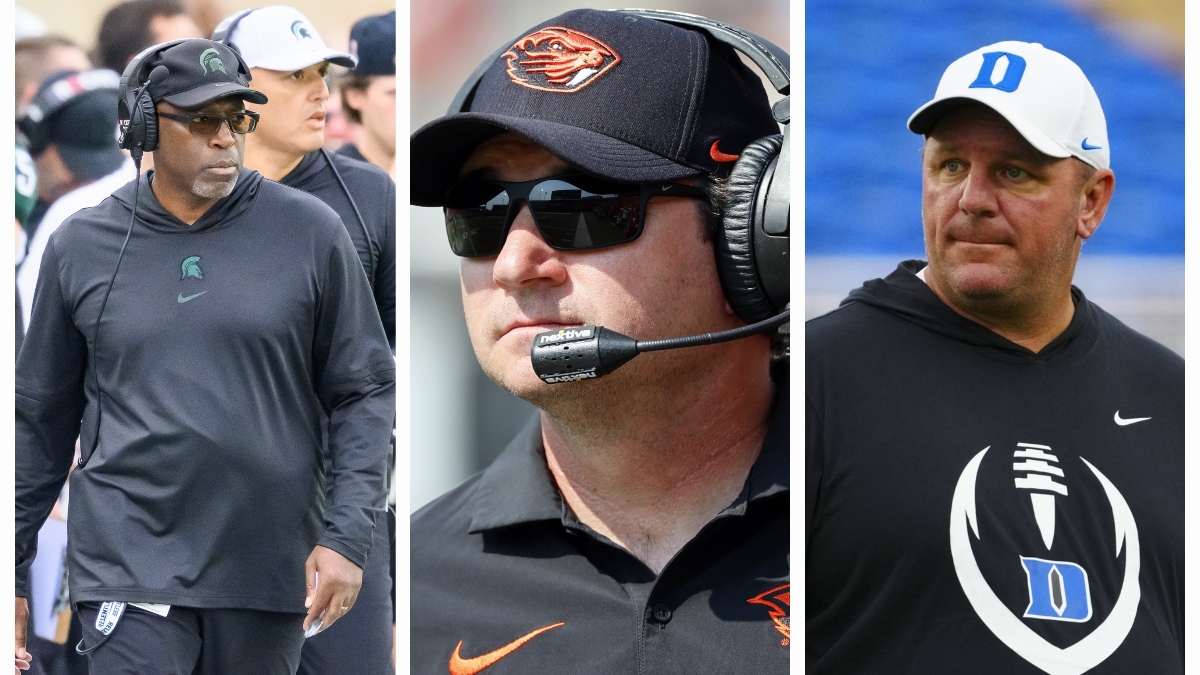
The other eight are: Mike Elko at Duke, PJ Fleck at Minnesota, Jonathan Smith at Oregon State, Jake Dickert at Washington State, Shane Beamer at South Carolina, Kalen DeBoer at Washington, Dan Lanning at Oregon and Scott Satterfield at Louisville, but Satterfield felt the hot seat at Louisville at the end of the 2022 season and stepped down to take a semi-lateral move to Cincinnati.
Beamer is off to a decent start at South Carolina, he would not be looking to move, nor would Michigan State value him over Elko or Smith. Lanning is just getting started at Oregon and although he doesn’t have a rich contract there, I don’t think he would look to leave after one year.
Of the realistic eight, I would imagine Elko, Fleck, Smith and Dickert would be of interest to Michigan State, pending their performances this season.
It’s a short list of Power Five winning coaches under the age of 50.
Increase the list to include 51-year-olds, and you can add North Carolina State’s Dave Doeren and Kansas State’s Chris Klieman. More on Doeren later.
Still feeling like a “Top 25 hire” is a simple thing?
**
Earlier, I listed 34 “tier three” programs and none of their current head coaches came directly from Power Five head coaching jobs. Only six of the 34 coaches at “tier three” programs were hired from Group of Five (mid-major) FBS head coaching jobs.
If I had put Michigan State in the “third tier,” Michigan State would have been the one and only school in this tier which hired a head coach from a Power Five school (Tucker, from Colorado).
I’m not trying to win any arguments or douse expectations, but it is important to define terms and gain an understanding of the actual coaching landscape. The list of active college coaches whom you might view as a “Top 25 program” hire is a short one. If you expand the net to include NFL assistant coaches, or coaches on the sideline (such as Urban Meyer), the pool can become stronger.
In coaching, if you stay at a Power Five school for more than six seasons, you might do a decent job by that school’s standards, but your attractiveness tends to wear off, simply due to accumulating losses (see Dave Doeren at NC State, Pat Narduzzi at Pitt, Matt Campbell at Iowa State). In the eyes of some, you’re a more attractive candidate if you’re a young, one-year wonder in Conference-USA or the Sun Belt Conference with an open book of unknowns than a nine-year vet with a major conference championship like Narduzzi.
What if Doeren goes 9-3 at NC State this year? Last year was supposed to be his breakthrough season, but it didn’t quite happen, despite wins against Florida State, Wake Forest and North Carolina. If he goes 9-3 this year, that would be four 9-win seasons in 11 years. Judging by the hot lists and message boards, most people seem more enamored with a single 9-win season by a coach from Marshall.
I love Duke head coach Mike Elko as a candidate. But are you ready to bet your car that he’s going to beat Doeren and NC State on Oct. 14? True, Elko has had only one year to get his program going and Doeren has had 11. But we tend to have an affinity for the coach with more unknowns in this sport. The coach who has won a little bit in a short amount of time has also had less time to accumulate losses and revert back to an 8-5 median, which isn’t a median at all. An 8-5 record is pretty good at most programs. But not in the coach hunt game. If you have too many of those, like Doeren or Narduzzi, you get marginalized from the popular hot lists.
I’ve used the phrase “the unknown is undefeated” in many aspects of sports observation. Well, the reciprocal is true too. The known is defeated. And that works against coaches who have been at a location long enough to have a string of 9-4 and 8-5 seasons draw scrutiny.
THE TOP TIER
For comparison’s sake, let’s look at the 20 top tier programs that I listed earlier:
Alabama: Hired Miami Dolphins head coach, 54, in 2007.
Auburn: Hired Liberty’s head coach (who had also been head coach at Ole Miss and Arkansas State), 53, in 2023.
Clemson: Promoted interim head coach and wide receivers coach, 38, in 2008.
Florida: Hired Louisiana’s head coach, 42, in 2022.
Florida State: Hired Memphis’ head coach, 38, in 2020.
Georgia: Hired Alabama’s defensive coordinator, 39, in 2016.
LSU: Hired Notre Dame’s head coach, 60, in 2022.
Miami: Hired Oregon’s head coach, 50, in 2022.
Michigan: Hired San Francisco 49ers head coach (and previously head coach at Stanford), 50, in 2015.
Nebraska: Hired Carolina Panthers’ fired head coach (and previously head coach at Baylor and Temple), 48, in 2023.
Notre Dame: Promoted Notre Dame defensive coordinator, 36, in 2022.
Ohio State: promoted offensive coordinator, 39, in 2019.
Oklahoma: Hired Clemson defensive coordinator, 51, in 2022.
Oregon: Hired Georgia defensive coordinator, 36, in 2022.
Penn State: Hired Vanderbilt head coach, 41, in 2014.
Tennessee: Hired Central Florida head coach, 43, in 2021.
Texas: Hired Alabama offensive coordinator (and former head coach at Washington and USC, where he was fired), 47, in 2021.
Texas A&M: Hired Florida State head coach, 51, in 2018.
UCLA: Hired former 49ers head coach (and former Eagles head coach and Oregon head coach), 54, in 2018.
USC: Hired Oklahoma head coach, 39, in 2022.
The Takeaways: In this tier, only LSU (Brian Kelly) hired a coach who was older than 54.
In this tier, the pool of coaches is the most diverse: Five were head coaches at the Power Five level immediately preceding their current jobs; four were Group of Five head coaches; four were Power Five coordinators; three were promoted from within, and three were NFL head coaches (although one, Matt Rhule of Nebraska, had been fired).
Only in this tier do you see baller moves like USC stealing Oklahoma’s coach, LSU stealing Notre Dame’s coach, or Miami stealing Oregon’s coach.
WHAT IT MEANS, PART II
Michigan State isn’t in the category of an LSU or a USC that can lure a Brian Kelly or a Lincoln Riley across the country.
But it’s foolish to criticize the idea of hiring a mid-major coach.
Eight of the 29 “tier one” and “tier two” programs hired from the mid-major level. Florida hired Billy Napier from Louisiana, Florida State hired Mike Norvell from Memphis, Tennessee hired Josh Heupel from Central Florida. Washington hired Kalen Deboer from Fresno State. Wisconsin hired Luke Fickell from Cincinnati. Ole Miss hired Lane Kiffin from Florida Atlantic. Missouri hired Eli Drinkwitz from Appalachian State.
Some of those mid-major hires had Power Five experience (Freeze at Ole Miss and Kiffin at Tennessee and USC).
Some of those mid-major hires got off to rocky starts (Norvell at FSU). Meanwhile, Napier at Florida continues to struggle, although he had a big win last weekend over Tennessee.
Heupel got off to a rocky start at Tennessee, had a good year in 2022, but lost to Florida last weekend. Stock can drop quickly in the SEC.
Louisiana, Fresno State, Cincinnati and Central Florida are a step up from Mid-America Conference schools. They are what some basketball coaches would call “mid-major plus” programs. Marshall is in this category as well. Cincinnati and UCF, having joined the Big 12, are no longer mid-majors at all.
MAC schools are mid-majors.
Michigan State would be wise to keep an eye on rising coaches in the mid-major plus category. It remains to be seen if candidates will rise, like Kalen DeBoer did in his second season at Fresno State in 2021, going 9-3.
As for mid-major plus candidates, Marshall’s Charles Huff, South Alabama’s Kane Wommack and Liberty’s Jamey Chadwell, formerly of Coastal Carolina, are on the rise.
Should Michigan State feel that it is superior to Iowa State, North Carolina State and Wake Forest, each of which found successful coaches from the MAC? Maybe, but it’s best to have some backburner candidates available, in case the table cloth gets ripped out from under Michigan State like it did when Luke Fickell abruptly changed course in 2020.
Some observers are quick to dismiss Toledo’s Jason Candle and Eastern Michigan’s Chris Creighton as being below Michigan State’s grade. But history would suggest that Michigan State would have been smart to hire Urban Meyer from Bowling Green in 2003 rather than John L. Smith from Louisville.
Also note that Central Michigan’s Brian Kelly finished in the top three in Michigan State’s 2006 coaching search when the Spartans hired Mark Dantonio from Cincinnati.
It’s not likely that a top Michigan State candidate will emerge from the MAC. But its ignorant to preclude them from a watch list of 10 or 15 candidates as the 2023 season develops. If a coach in the MAC goes 10-2 or 11-1 this year, history indicates that Michigan State shouldn’t leave that rock unturned.
When looking for successful head coaches in other conferences who could emerge as candidates for Michigan State, there might be one or two in the Big 12, and one two in the ACC, one or two in the Pac-12, and one or two in each mid-major conference who will have a palatable resumé, a good season in 2023, and be of prime age. From there, which of those candidates are a character and personality fit? That question could further shrink the pool.
It’s a slim pool in a very competitive market.
ADD IT ALL UP
What did we learn from the above study: Of the “winning” Power Five coaches under the age of 50, Oregon State’s Smith and Duke’s Elko look like intriguing, rising coaches right now. But let’s see what their records looks like in November. And then we will cross the hurdle as to whether Smith would entertain leaving his alma mater for a shining outpost in the Midwest. For now, he’s busy coaching the No. 14 team in the country, and doing it quite well.
Dickert is just getting started, and was a “winning” Power Five coach last year by only one game, going 7-6. What if he goes 7-6 again this year? Does that kill his candidacy? The known becomes defeated, and less palatable. But his team is ranked No. 21 in the nation right now. What if he goes 9-3, or better, in the deep, tough Pac-12? The records that these candidates put forth this season will be critical.
In the under 50 category of winning Power Five coaches, you can make a call to Minnesota’s Fleck or Washington’s DeBoer, if you’re prepared to fork over big cash, yet you may still get turned down. And there will be buyouts to consider.
Meanwhile, just above that age bracket, there’s rock solid 51-year-old Chris Klieman at Kansas State, with his FCS National Championships at North Dakota State, and a Big 12 Championship last year at K-State.
And there’s 51-year-old Doeren, with Midwest ties as a former defensive coordinator at Wisconsin. You might not be ready to put him on a hot list right now. But what if he beats Huff and Elko back to back in October?
As a hard-ass, old school Midwestern defensive ball coach, with a good, not great, record, he has actually overseen a program successfully for an extended period of time. A 10-year run for someone of his relative youth in this sport is not common. Personality-wise, Doeren probably shares more similarities to Dantonio than anyone on this list, if you’re into that.
None of these candidates wow you? You don’t think they’re “Top 25 program” material? Maybe your definition of “Top 25” is actually “Top 15.”
Go back and revisit Michigan State’s peer group in “tier two,” and check to see who those “Top 25” programs hired.
Arkansas hired Georgia’s offensive line coach. Iowa hired the Baltimore Ravens’ offensive line coach. Ole Miss hired Florida Atlantic’s coach. Missouri hired Appalachian State’s coach. South Carolina hired Oklahoma’s tight ends coach. Washington hired Fresno State’s coach. Wisconsin hired Cincinnati’s coach.
Do those look like “Top 25 program” hires? Yes they do, because they are – like it or not.
Meanwhile, the unblemished record of coordinators like Ohio State’s Brian Hartline move the needle with some observers. Why? Because he’s never lost a game! We’ve never seen him sweat. Surely he’s better than those other guys who have lost games, right?
College coordinators and NFL assistant coaches increase the candidate pool. And that’s a necessity, especially in the “third tier,” considering the shortage of young, winning Power Five coaches that are available.
As for Michigan State as part of the mythical “third tier,” could the Spartans roam outside the pool of Power Five head coach candidates if and when the coach watch becomes a coach search?
We will take a closer look at assistant coaches, as well as a deep dive on Group of Five darkhorses, in the next installment of our series as Michigan State’s coach watch continues.
The post Coach Watch: Can Michigan State make a ‘Top 25 Program’ hire? Let’s delve into what that means appeared first on On3.