Advance Scouting: Penn State vs Ohio State – OSU offense
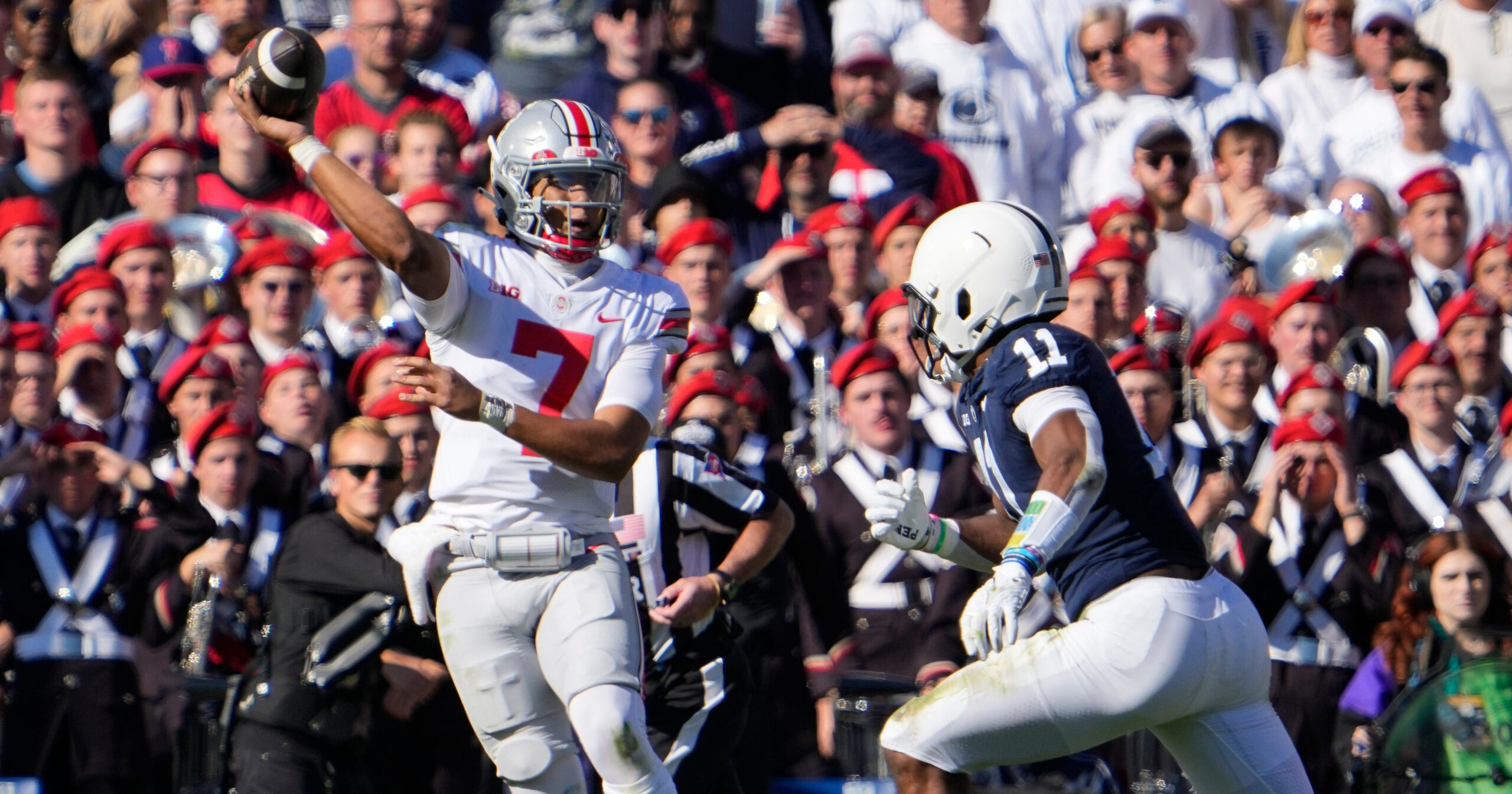
Penn State Football takes on UMass this weekend for its 2023 Homecoming game. Even though the team faces a non-conference, non-FBS team in October, head coach James Franklin has his team locked in on the game this weekend.
However, we are not bound by those rules and are free to look ahead. So today, we will examine the Ohio State offense in a preliminary scouting report of the Buckeyes. If you’ve had a chance to see the team at any point this year, you’ll notice that something seems off about its offense. After watching some film of this group, we’ll dive into the numbers to illustrate some of the issues they’re facing in 2023.
PFF provides stats in this article.
Explosive concepts: The bedrock of Ryan Day system
If you were to optimize an offense based on the “numbers” in advanced analytics, you’d get a system reasonably close to what Ohio State runs under Ryan Day. Most of their running and passing systems are designed to create chunk plays. The running game is heavily based on the outside zone concept, a somewhat boom-or-bust running scheme that produces, on average, more positive and negative runs than any other system.
They also use passing concepts that stretch the field vertically. This style floods the second level of the defense with receivers, making safe zone coverages dangerous in one-on-one situations with their elite receivers. When Penn State offensive coordinator Mike Yurcich was with the Buckeyes, he oversaw this part of the offense. When this system hums, they’re stretching an offense laterally, with zone action, and vertically with their passing concepts (See COVID 2020 game).
So before we move any further, we need to understand that we’re comparing Ohio State primarily to itself, not other offenses. The bar of production in this offense has been incredibly high. We’ll provide some references to Penn State, but the primary point is that this offense isn’t clicking at the same level it did in years past.
Running game lacks consistency, just like Penn State (but different)
The boom in the offense has been there in the running game for Ohio State. The top three Buckeyes running backs have hit on runs outside the tackles (not just outside zone) to the tune of 31 carries for 287 yards in the first five games. Averaging 9.2 yards per rush isn’t the worst problem in the world.
The issue for this group is that they’re struggling to make progress running between the tackles. If you target the A and B gaps, that average per rush plummets to 3.8 yards per carry. For reference, Penn State’s much-maligned offensive line is averaging 4.6 yards per carry when running between the tackles. Ohio State has never been a grind-it-out team, and this falls in line with what they’ve accomplished in recent years. They’re converting less, but the overall production between the tackles remains the same through five games.
In many ways, the Penn State and Ohio State running games are similar but have the inverse issue.
Offensive line not protecting as well
The most noticeable difference about the Ohio State offense is its offensive line in pass protection. Day’s offensive system stresses the offensive line, especially the tackles, to hold up in pass protection. While they do get help from chips by backs and tight ends, Josh Fryar and Josh Simmons rarely have extra protection, with all five players routinely out in pass patterns.
As a result, they’ve seen 70 true passing situations through four games. Fryar has allowed four pressures and one sack, while Simmons has given up seven pressures and three quarterback hits.
For comparison, Olu Fashanu leads the Big Ten with zero pressures allowed but has seen 24 fewer pass blocks. Caedan Wallace has seen 51 true pass sets and has given up three pressures and one sack.
But the real comparison is to Ohio State’s tackles from last season. Dawad Jones gave up two pressures all season in 2022, and Paris Johnson allowed eight pressures and two tacks. So essentially, the tackle this year has given up an equal number of pressures and sacks through only five games.
Center Carson Hinzman has also caused an issue, with pressure up the middle this year. His PFF blocking grade is 15th out of 16 eligible centers, and he has surrendered five pressures.
Kyle McCord not faring well under pressure – a Penn State special
Honestly, Ohio State quarterbacks have rarely fared well under pressure through the years. Few quarterbacks thrive when the defense gets home, but the offensive system leaves fewer options if the defense gets home quickly. That, plus more opportunities to get home, puts the Buckeyes in more pressure situations.
The difference is how Kyle McCord is responding to said pressure. So far this season, he’s completing 37.5% of his passes and has connected 12 times for 61 yards on 32 attempts. That’s 1.9 yards per pressured attempt.
In other words, pressure is affecting his ability to run the offense. When under pressure, McCord’s average target depth drops to 8.9 yards from over 10 in normal situations. This means he’s checking down and doing it poorly. While CJ Stroud wasn’t electric in pressure situations, he still managed to operate the offense. In fact, he became more aggressive when blitzed, trying to find his explosive playmakers downfield in single coverage or more sparse zones. Stroud managed an aDOT of 12.0 yards downfield in 2022.
Ohio State still dangerous, but less consistent
Like Penn State, Ohio State’s conference games haven’t been blowout affairs. They only scored 23 points against Indiana and were down 17-10 against Maryland in the third quarter before the Terrapins imploded, and the score snowballed to 37-17.
Ohio State is still one of the most dangerous teams in the country, with Marvin Harrison Jr. and Emeka Egbuka on the outside. But McCord doesn’t seem to have the same skills at Fields and Stroud. They have the explosiveness but lack the consistency on a drive-to-drive basis.
Harrison Jr best illustrates this fact in his target depth breakdown. If possible, he’s more dangerous this year on deep passes, catching 60% of them and averaging 50 yards per completion. You cannot let him get free into the secondary, or McCord will find him.
But the pressure from the tackles is affecting the intermediate passing game. McCord and Harrison Jr don’t connect on plays 10-19 yards downfield to keep the chains moving with chunk plays that don’t score. Harrison Jr caught 66.7% of his targets through five games last year. This year, he’s connecting with McCord on just 23.5%.
What we’re watching for when Penn State defense takes the field
The most apparent situational advantage that Penn State has this year is that they’re getting pressure at an incredible rate. After a slow start, the defensive ends have taken over the last few games for the Nittany Lions. With issues at center and less effective tackles, Penn State can throw a couple of wrenches into the gears of the Ohio State offense. The defense has done an impressive job of containing most rushing attacks, but an explosive run is only one busted gap away. The question is whether Penn State’s secondary can keep a lid on Harrison Jr and the rest of Ohio State’s explosive athletes.
The post Advance Scouting: Penn State vs Ohio State – OSU offense appeared first on On3.