DotComp: Crossroads coming soon for Harlon Barnett, Noah Kim and Michigan State
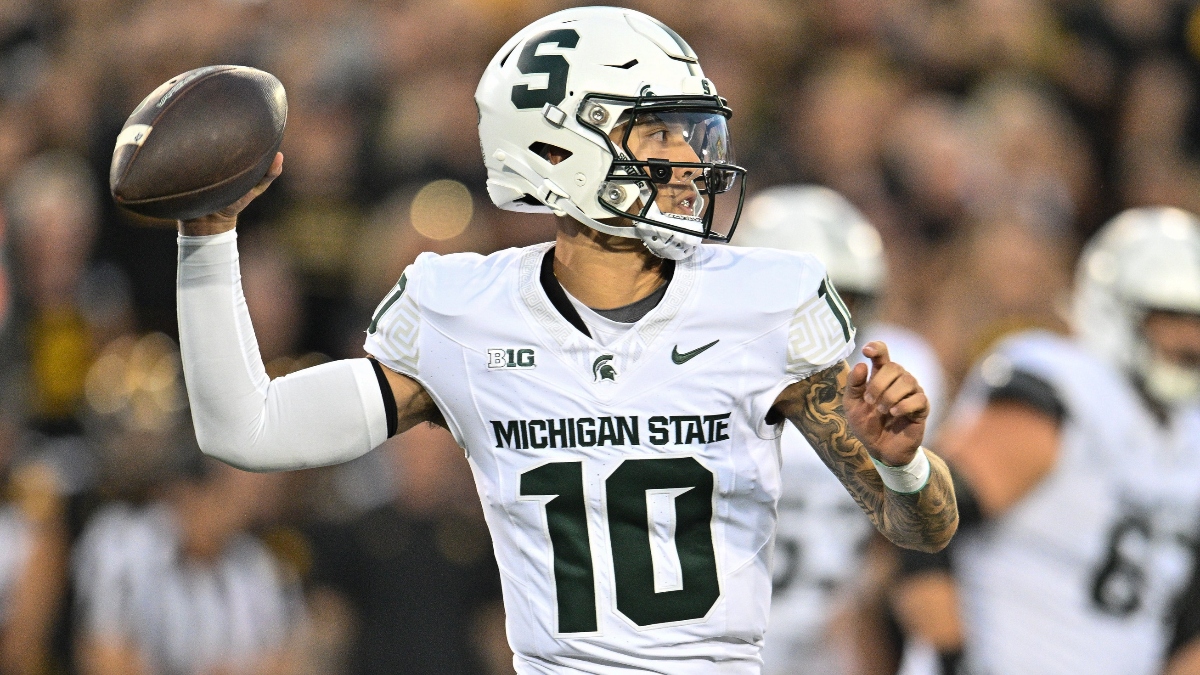
Iowa City, Iowa – With Michigan State having lost three straight games and junior quarterback Noah Kim struggling to help the team find a winning rhythm, interim head coach Harlon Barnett said the starting quarterback position will be in question heading into the bye week.
That’s a different stance than Barnett’s statement after last week’s loss to Maryland, when he said Kim was QB1, despite being relieved in the fourth quarter of the loss to the Terrapins.
“We will watch the film very closely,” Barnett said after Saturday’s 26-16 loss at Iowa. “We have two weeks. That’s a good thing.”
The Spartans will play at Rutgers on Oct. 14.
“Jay (Johnson) and I and the offensive staff will all talk to see if something needs to be done or not and evaluate it, and being very, very realistic and fair at the same time,” Barnett said. “Everybody is always being evaluated and there is always competition going on. It’s no different than at any other position.”
Kim was 25 of 44 for 193 yards with no touchdowns and three interceptions against Iowa. One of the interceptions was a desperation throwaway with :10 seconds left and likely won’t enter in the evaluation.
But Kim’s first interception was a costly one. On first-and-10 from the Iowa 20-yard line during Michigan State’s fourth possession of the game, with the Spartans leading 6-3 and gaining momentum, Kim tried to hit Montorie Foster on a stutter-and-go route in the end zone.
Cooper DeJean, who is likely to become a two-time All-Big Ten selection this year, played off coverage on Foster. DeJean didn’t bite on the stutter double move. DeJean continued to get depth. Foster wasn’t open.
That’s the type of situation that the coaches have been tutoring Kim about, telling him not to force it, if it wasn’t there – especially against this Iowa defense that forces turnovers better than any unit in the country.
But Kim is an optimistic competitor – sometimes to a fault, we’re learning. He thought his teammate could make a play on a 50-50 ball, and he had confidence in himself that he could deliver it with the type of pinpoint accuracy that was needed to salvage that play.
But Kim ended up putting the ball in a place where only DeJean could catch it.
And it was that same type of overzealous optimism that resulted in a costly Kim interception last week against Maryland after center Nick Samac snapped the ball to him too early in the cadence, again on a first-and-10 with Michigan State gaining momentum. Instead of throwing that pass away and coming back to start fresh on second-and-10, Kim thought he had a chance to give his receiver a shot at a 50-50 ball along the sideline.
These weren’t good decisions. They were also learning moments. I’ve seen inexperienced quarterbacks make errors like these, learn from them, and decrease the propensity of repeating similar mistakes as experienced was gained. It’s part of the process, as Mel Tucker used to call it, stealing one of many lines from Nick Saban.
The process showed some progress on Saturday. Kim was uneasy and jumpy in the pocket last week against Maryland, still bothered by the blasts he took in the Washington game. But Kim trusted his pass protection more in this game, stayed in the pocket longer – sometimes delivering good passes, sometimes depositing it safely out of bounds. But he stayed in the pocket longer. That sounds simple, but it was progress.
He had some good moments in each scoring drive. He delivered a nice pass to Maliq Carr on a 16-yard hook during Michigan State’s second possession, which led to a field goal and a 3-3 tie.
He found Foster on a slant for 9 yards during the drive which ended with a Jonathan Kim filed goal and a 6-3 lead in the first quarter.
He had his best moments on the last drive of the first half when he found Foster on a square-in for 16 yards – his best pass of the night, triggering a successful two-minute drill.
Also on that drive, Kim felt the rush on one play, stepped up in the pocket, improved his line of vision and passing angle as Foster came back to the quarterback on a semi-scramble rules pass for 16 yards.
And then Noah Kim hit Foster again on a quick comeback for 9 yards with :04 seconds left in the game, providing just enough yardage and time for Johnathan Kim to bang a 58-yard field goal.
Then after Cal Haladay returned a fumble 42 yards for a fumble and a 16-10 lead, the tenor changed for Kim, the play calling and changed task of protecting a lead rather than chasing a lead.
I can’t say that I criticize the conservative tack that the Spartans and offensive coordinator Jay Johnson took in the fourth quarter. All week, I had prescribed the unlikely path to victory at Iowa as an 11-point underdog to be precisely what was beginning to unfold in this game: stop the run, make Iowa beat you through the air, don’t turn it over, punt. Do those things, and you will be in this game all night.
Michigan State did three of those four things well for most of the game. Then the punt portion fell apart, with a 15-yard shank which set up Iowa’s tying field goal, and an error in directional punting which set the table for DeJean’s 70-yard punt return for a touchdown.
I can’t rip Michigan State’s coaching for doing exactly what I said they needed to in my pre-game analysis. You can criticize it, and you might be right. But I saw sound logic in Michigan State’s approach, including the decision to tighten the reins on Kim once Michigan State established a lead in the second half.
You may think that Michigan State should have gone with Houser after Kim’s interception on an overly-ambitious pass to the side side of the field intended for Foster on the first drive of the second half.
But MSU’s defense responded with Haladay’s scoop-and-score.
At that point, do you pull your starting QB when he has a lead on the road at Iowa? And do you replace him with a redshirt freshman in the first nut-crunching assignment of his college life against the trickiest pass defense in the country?
Meanwhile, Michigan State had some new wrinkles on offense which helped put a little bit of fuel into the evening. Michigan State did a good job of getting some sprint-out passing going for Kim. Also, there were new plays in which Kim faked a handoff and then worked with a delayed sprintout. And there was new use of orbit motion to get a flanker open for athletic, ball-control swing passes and semi-bubble screens. Those 25 completions had to come from somewhere, and Michigan State devised a few ways to move the chains.
But the Spartans had a turnover in the red zone, and settled for four field goal attempts. That was too much like the empty red zone trips of last weekend.
As this season circles the drain with a 2-3 record, and no one knowing who is going to be the head coach next year, nor how much of the current roster will return, Barnett’s patience for the process is understandably wearing thin.
Redshirt-freshman Katin Houser might have been more error-prone than Kim if he had played in this game. But we’ll never know for sure.
As for Kim, he listened to the coaches in the fourth quarter as Michigan State tried to protect leads of 16-10 and 16-13. They didn’t want him taking any chances against this Iowa defense.
Yet he was tasked with trying to pad the lead in the fourth quarter, and then break the tie in the final minutes, and then to find the tying points in the waning stages. He couldn’t deliver, and honestly wasn’t given full confidence to try to make it happen. He was clearly coached to throw it away safely on third down if no one was open, rather than heave a 50-50 ball. I agreed with that approach, when Michigan State was clinging to the lead, and Iowa was showing little life on offense, and the Spartan defense was winning most downs. Kim listened, he learned, but that didn’t end up working, either.
So Michigan State loses this game without knowing what would have happened if they had given Kim more leeway to throw aggressively throughout the fourth quarter. Maybe more interceptions would have come.
And Michigan State doesn’t know what would have happened if they had leaned more heavily on a successful run game on first and second down. Fans would have hated a turn to a conservative run game on first and second down while nursing a lead, but running back Nate Carter averaged 5.1 yards per play on this night, and that approach might have worked.
Or Michigan State could have went with Houser midway through the third quarter after one of the Spartans’ empty drives.
Or it’s possible that none of those options would have worked.
All that we know is that the one that was chosen – sticking with Kim, and giving him a short leash – didn’t work, largely because of two failed punts. Kim didn’t make the big mistake in the fourth quarter. He turned it over to the defense to bring it home, but special teams failures short circuited the project.
Now, the Spartans will have a bye week before preparing for a trip to Rutgers in early October. The Spartans must come home from New Jersey with a victory, or a new quarterback, or possibly both, as Barnett tries to find a miracle.
The post DotComp: Crossroads coming soon for Harlon Barnett, Noah Kim and Michigan State appeared first on On3.