How Brent Venables is shifting the culture at Oklahoma
An emotional Craig and Gail Box stood in front of the Oklahoma football team prepared to tell the story of their son, Austin.
It had been nearly 12 years since the two had been on Oklahoma’s campus — Nov. 26, 2011, to be exact. It was then that Austin was honored at OU Senior Day. Six months prior, on May 19, 2011, Austin died after accidentally overdosing on prescription painkillers.
A lot has changed in Norman since the Box family stepped foot on Owen Field. Most notably, Brent Venables, who recruited Austin Box from Enid, Okla., and coached him for four years at OU, is now the head coach. Venables and the Box family have remained close, despite Venables leaving to be Clemson’s defensive coordinator a few weeks after what would’ve been Austin’s senior day at Oklahoma.
“The relationship goes well beyond the field,” Venables told SoonerScoop.com in a one-on-one interview. “We shared a lot of amazing experiences together through the game. But most importantly, connected forever through their son. So it’s meant a lot. They’re amazing people. And they’ve got a great platform to affect and change lives. Helping Austin’s legacy stay alive is important to all of us.”
On Aug. 14, Craig and Gail returned to Norman to speak to Venables’ team — “Team 129” — about their son and their foundation, the Austin Box 12 Foundation, which educates the public on the dangers of prescription drug abuse.
“Candidly, it had always just been too painful to go back,” said Craig, who has remained an OU fan from a distance for the past 12 years. “But when Brent called me and asked me and my wife to speak with the team, I couldn’t say no… When Austin passed away, Brent really showed his human side. And that’s kind of stuck with us since then.”
Dec 4, 2010; Arlington, TX, USA; Oklahoma Sooner linebacker Austin Box (12) celebrates after recovering a fumble in the third quarter against the Nebraska Cornhuskers during the Big 12 championship game at Cowboys Stadium. Mandatory Credit: Matthew Emmons-USA TODAY Sports
Entering his second year at Oklahoma, Venables has demonstrated an effort to make those types of connections with each of his players, on and off the field. He’s attempting to not necessarily change the culture at Oklahoma — a culture built on winning — but to shift it. His philosophy, a blend of ideas from college football giants Bill Snyder, Bob Stoops and Dabo Swinney, is formulated in tight bonds made by playing a game that has defined his life. Venables believes cultivating strong relationships off the field will ultimately culminate in success on it.
Year 1, though, didn’t go to plan.
Oklahoma lost five one-score games and clearly lacked its standard of talent, resulting in the school’s first losing season since 1998. That’s led some to question whether Venables is the guy to lead Oklahoma into the SEC in 2024. And it’s clear this season is pivotal, given an easy schedule and replenished roster leave the Sooners no excuses to be bad in 2023.
Though, inside the program and to those who know Venables best, there’s still plenty of optimism he has Oklahoma heading in the right direction. Why? Because he’s building a “relational-driven program, not a transactional program,” as he stated Dec. 6, 2021, in his opening press conference. And while that hasn’t helped Oklahoma win yet, it has resonated with those in the Switzer Center, as well as those who helped build it.
“His passion, his commitment, his track record of success, and his process, to me, gives a lot of confidence that Brent will turn this thing around,” said Bob Stoops, who hired Venables at Oklahoma in 1999. “I really believe a huge jump can be made in the second year when everybody’s used to the expectations, everybody understands the way they do everything. I believe the change in culture from Lincoln to Brent was something to get used to. That can be challenging. But I think things can really turn around this year and make it a much different year and I believe that will happen.”
Venables and Riley are polar opposites. Riley, one of the best offensive minds in football, built his program around elite offensive talent and playcalling, masking one of the worst defensive units in college football with Heisman Trophy winners and high-scoring College Football Playoff losses. Venables, one of the best defensive minds in football, builds programs around his complex defensive scheme led by five-star talent, specifically, defensive tackle — like David Stone, who on Saturday night became his first such commit at Oklahoma.
The juxtaposition goes beyond schematics, though. At his core, Venables is a people person.
Whether that’s in recruiting the best defensive linemen in the country, raiding rival schools and Division II national champions in the transfer portal, hiring a staff made primarily of his former players, helping persuade administrators to build facilities, improve NIL funding, and update tailgating policies, or inviting a former player’s family back to share their son’s powerful story.
“Brent has unshakable confidence in what he believes in and what he’s trying to do,” Craig said. “And that’s based on his experiences and his personality, and I think the fact that he won’t vary from that and his players will see that, it will eventually become what everybody wants it to be at Oklahoma.”
Now 20 months into the job and five days from the 2023 season opener, Venables anticipates the culture shift that is taking place off the field will generate results on it. And for him and Oklahoma, that shift will happen one game, one player and one relationship at a time.
“I don’t think any locker room or business or family can truly be great if they’re not connected first,” Venables said. “I think that’s what it all starts with. And I think it’s got to come from genuine, authentic relationships. Where there’s love, trust, respect, and appreciation. I think that’s the root of it all — relationships. That’s why life’s worth living. That’s what it’s all about to me. It’s being able to be a part of something bigger than yourself.”
One game.
Oklahoma football coach Brent Venables reacts during a game. (Bryan Terry / USA TODAY Sports)
Venables addressed “Team 128” one final time in the bowels of Camping World Stadium in Orlando, following the team’s fifth one-score loss of the year.
“I know what the standard is here and so do you,” Venables said after the team fell 35-32 to No. 13 Florida State in the Cheez-It Bowl. “What I know, is we competed to the standard today. We fought to the standard today, we had guts, we had courage, we had belief, we had fight, we had toughness, we had physicality… I’m proud of you. And I’m telling you — keep your freaking head up. Should you be hurt? You’re damn right. Because you invested and when you invest a lot, it hurts when you come up short.
“128, the foundation’s been laid.”
Venables has been here before. When he joined Bob Stoops’ staff in 1999 as the co-defensive coordinator, Oklahoma was in bad shape. And that first season didn’t go to plan either.
“Yeah, they went through a similar year we had my first year. But we were able to come out of the close games a little more than they did,” said Bob, who went 7-5 his first season.
Venables and Oklahoma struggled in close games in 2022. That’s no secret. The blame, though, is a debate. Clock mismanagement against West Virginia, poor quarterback play against Baylor, lack of defensive talent against Kansas State and key injuries against Texas and TCU.
“It was rough, man,” safeties coach Brandon Hall said. “A lot of it was rough because of the way it happened, losing five games in the fashion that you did. Coach Venables is a very prideful person. If anyone understands the history and the tradition of this program, it’s me. We’re fixers. That’s why we get into coaching. We want to fix people. We want to make people better. And we want to build. You’re just trying to find ways to get over the proverbial hump. It’s hard. It takes a toll on you.”
Following the 1999 season, Stoops and his staff re-evaluated their approach. Stoops didn’t change his core beliefs that spring and summer, but did make adjustments to best fit his players and staff. And no one wavered. He had only one staff turnover — offensive coordinator Mike Leach, who left to be the head coach at Texas Tech.
Stoops won a national title in year 2.
“No egos — we just wanted to win and find the best way to do it,” said Mike Stoops, who was co-defensive coordinator with Venables from 1999-2003. “We were trying to evolve as young coaches. Finding the best way to do things, working together. I thought we had a pretty cohesive group. We just had a very young passionate group of coaches. Him and I — we were just two meatheads trying to put the defense together.
“For (Venables) to instill his vision is going to take time. I don’t think it will take very long. I think Bob was able to do it in his second year. Whether it’s competing for a national championship or competing for some kind of championship, I’ll be surprised if (Oklahoma) is not.”
No one is predicting a national title run for Venables after a 6-7 first season. But Venables knows reaching the Big 12 title game and being in contention for the College Football Playoff is the standard at OU. Players are wearing shirts this fall camp that read on the front “Finish” and on the back, the date “12/2/23” – the date of the Big 12 Championship Game.
For the 2023 season to be a success, the on-field results have to be better. Specifically, game management. From the offensive tempo to the defensive communication to Venables’ use of timeouts. Almost all of Oklahoma’s game day procedures need improvement, which is why the staff immersed itself in situational football this offseason. That evaluation — similar to Bob in ’99 — started in January, days after the loss to Florida State.
Based on the little time the media saw spring practice and fall camp, things do appear smoother. Whether it’s spending less time teaching individual drills or practice being less taxing on players or Venables being on time for media availability — there is more day-to-day organization. The players are more comfortable, while the staff hasn’t wavered from their leader’s vision.
There’s a sense of urgency, but no one’s panicking.
“Yeah, we changed some things,” running backs coach DeMarco Murray said. “I won’t go into details on what was said or what was changed. But again, we made really good adjustments to making sure we give ourselves a great chance to win and just working on a lot of situational things this offseason. For us, it’s been great for our young guys. They’ve worked extremely hard and there’s 100% buy-in from the players, which that’s what you want. And by the staff and by the whole program so we’re on one accord.”
That buy-in will be what determines Venables’ fate at Oklahoma. He has to win. And there’s reason to believe he will, having done so at each of his previous stops.
But now, it’s his turn to drive the program back in the right direction, just as Bob did in 1999.
“Brent doesn’t need advice,” Bob said. “Brent’s got a lot of experience. It’s all been a great experience when you look at Kansas State, Oklahoma and Clemson. It’s hard to find a better background than what he has. All I do is I’m there as a sounding board if he ever needs anything and or encouragement — whatever.
“He’s going to give us a lot of great years to come. It just takes time.”
One player.
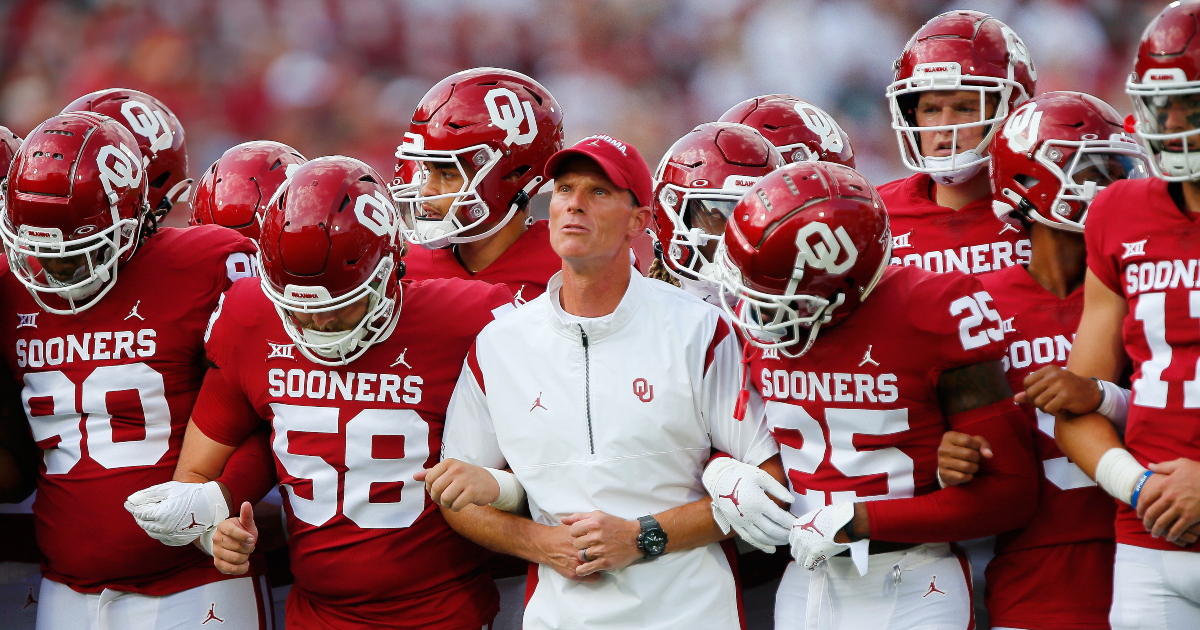
Oklahoma Sooners head coach Brent Venables lines up with his team after the Red River Showdown college football game between the University of Oklahoma (OU) and Texas at the Cotton Bowl in Dallas, Saturday, Oct. 8, 2022.
While Venables was interviewing for the Oklahoma head coaching job, he called Mike Stoops.
The longtime friends had worked together at Kansas State and Oklahoma. When Venables was a graduate assistant in Manhattan, he lived at Mike’s house for a year. And despite the awkwardness of Mike returning to Oklahoma to replace Venables in 2012, they’ve remained close.
So when he called Mike, he knew his old friend would shoot him straight. And Mike is more than familiar with the challenges given he saw Oklahoma deteriorate on defense firsthand. And that, in his opinion, will be Venables’ biggest challenge: persuading elite defensive players that OU is a place that does more than hang half a hundred on opponents.
“We just talked general specifics or coaches speak or issues or thoughts about the job — just the challenges ahead,” said Mike, now the linebackers coach at Kentucky for his brother Mark. “I think building personnel back up — nobody can coach bad players or players that aren’t quite good enough. I don’t care who you are. You have to have players to win at these levels, and win consistently in the conferences we play in and developing the roster that he wants.
“I think defensively (at Oklahoma), that’s always been an issue. We turned into an offensive team over the last whatever it’s been — eight years. So building a new identity and a new culture is never easy.”
The lifeblood of a program is recruiting. Landing a top recruiting class every year is the expectation at Oklahoma. Riley landed a top 10 class in four of his five years at OU. Venables is two-for-two and with players like Stone looking to go three-for-three.
But Venables own experiences coming out of Kansas State help him to not just identify measurable talent, but overall makeup that can define success in his program.
“I remember watching him play and thinking, he wasn’t the tallest, fastest guy, but he was such a good football player,” said Jim Leavitt, who was the linebackers coach at Kansas State from 1990-95 and found Venables at Garden City Community College. “His work ethic was unparalleled. His passion for the game was enormous and that’s what we were looking for.”
Venables has that same approach as a recruiter. It’s a full evaluation process for Venables.
“I just thought we did a great job evaluating people and taking people that might not be Johnny five-star, but they were a five-star on game day,” said Dan Brooks, who was Clemson’s defensive line coach from 2009-16. “The personnel got better and better throughout my whole time under Brent. He led that charge. He’s one of the best recruiters I’ve worked with.”
But Oklahoma has failed to land top defensive talent as of late. It’s why Mike was fired and why Oklahoma was 0-3 in playoff games under Riley.
Oklahoma has had 21 defensive players drafted since the 2013 NFL Draft, a year after Venables left. From 2000-12, Oklahoma had 30 defensive players drafted — 16 of those were in the first three rounds compared to only seven of the 21 since 2013.
By landing Stone on Saturday night, Venables secured the type of talent OU used to — and again must — attract.
“Oklahoma has recruited me as long and as hard as anyone,” Stone told On3. “Going to Oklahoma, I get to play for a great defensive line coach in Todd Bates and a great coach in Brent Venables who is great on the defensive side of the ball. Their system will be very beneficial for me as a defensive lineman because they know how to coach their guys up and where to line them up at to make plays. They did a great job of that at Clemson, and they’re building it at OU too.”
Stone’s commitment is arguably a bigger win than any of the six games Venables won his first season. In the recruiting world, landing a five-star defensive lineman is one of the most difficult things to do. In 10 years at Clemson, Venables landed seven five-star defensive linemen or ends. During that same 2012-22 span, Oklahoma landed one — Clayton Smith, who has since transferred to Arizona State.
Venables has now landed two in two years in Stone (class of 2024) and P.J. Adebawore (2023). He didn’t land his first five-star defensive lineman at Clemson until his third year.
“I don’t think there’s anyone more important than the guys who put their hand in the dirt and line up and go every day. Brent shares that philosophy,” Brooks said. “And kids know his reputation. They know what he did at Oklahoma and Clemson. They want to play for him. It might just take some time to land some of those top guys. But they’ll start coming to Oklahoma.”
If they do, Venables’ chances of succeeding increase exponentially.
“His ability to motivate and communicate with his players is very genuine and very real,” Mike said. “And the players read that. They know exactly what’s going on and what you’re there for. And I think Brent was always approaching his players to be the very best with no credit. That’s why guys want to play for him.”
One relationship.
Sep 3, 2022; Norman, Oklahoma, USA; Oklahoma Sooners head coach Brent Venables waves to fans after the game against the UTEP Miners at Gaylord Family-Oklahoma Memorial Stadium. Mandatory Credit: Kevin Jairaj-USA TODAY Sports
Venables was the first coach to arrive at Mercy Medical Center the morning of May 19, 2011.
He sat with Craig and Gail Box for an hour while they mourned their son. The Boxes say they don’t remember much from that day. But the one thing they do remember is Venables’ message.
“Something good will come of this,” Venables told them. “Something good will come of this.”
Not long after Austin’s death the family started the Austin Box 12 Foundation.
“That has stuck with my wife and I for years. And that was a big part of the inspiration for the work that we do and creating the foundation,” Craig said. “I’m biased and I think a lot of him as a football coach. I saw how demanding he was and how intense he was. But I think more of him as a person.”
Venables and the Box family have remained close, even after he went to Clemson. Craig texted Venables after winning national titles in 2016 and 2018. Venables always responded, asking how his family was doing. And as OU’s new coach flew into Norman on a private plane Dec. 5, 2021, Box texted him while watching his arrival on TV.
“Welcome home, Brent,” the text read.
Minutes later, Venables responded. “Hey Craig! Thanks, can’t wait to see y’all. Appreciate you.”
“Austin was no longer his player. We were no longer parents of one of his players,” Craig said. “And a lot of coaches, I’ll be real honest with you, once a player is done with eligibility there are coaches that don’t really care. They’ve got to focus on what they’re doing and they’re not invested in any kind of relationship. But I just sensed from Brent that there was an investment there from the beginning.
“When we were there,” Craig said of his recent visit, “I felt bad because we spent a lot of time with us one-on-one. And he was right in the middle of fall camp. I remember thinking, ‘Brent, don’t you have stuff to do?’ But it’s not fake. He just really cares about people. He cares about his players.”
For Venables, staying in touch with the Box family was not only natural, it’s part of that bigger-than-football intentionality that defines him as a man and coach. And if anyone can relate to family hardships, it’s Venables. He grew up with four stepdads after his biological father left when he was 2. He lost his mom to cancer in 2005 and he lost his brother in 2011 – one day after Austin’s death. And his wife, Julie, was diagnosed with breast cancer this summer.
Still, Venables isn’t one to sulk.
“I think I was a benefactor of a lot of amazing relationships,” Venables told SoonerScoop.com. “People for whatever reason that I came across in my life that enriched my life and gave me opportunity, poured wisdom into me, and helped carve a pathway for me. I’m a benefactor of a lot of amazing relationships. So for me, I have an obligation and a responsibility to pay it forward.”
It’s that kind of mentality that has inspired the foundation on which Venables is building his program. It’s why he created the S.O.U.L. mission, which helps his players learn valuable life skills while building invaluable relationships.
“That’s really what blew my wife and me away,” Craig said of the S.O.U.L. mission. “I had heard about it and generally understood it, but seeing the purpose of it and the intent of it and the resources that are invested in it for the benefit of the player, not just the football player. That is something that I think is a part of Brent’s culture. And I think that’s something he’s learned and developed over the years.”
Venables has grown as a coach over the past 30 years, bringing pieces of every program he’s been at with him to Oklahoma. The S.O.U.L. (Serving Our Uncommon Legacy) Mission exemplifies that, replicating Clemson’s P.A.W. (Passionate About Winning) Journey.
For Venables, “everything matters.” Not a single corner is cut, from recruiting the right kids to aligning the right way on defense to teaching his current players about a danger that took one of his player’s lives.
“I think part of that is — I don’t want to say inspiration — but part of it is learning and knowing the mental and emotional toll playing at that level,” Craig said. “Particularly when they go through injuries and life’s typical ups and downs that people go through. That’s a big part of the culture he’s trying to build with the players — just being people versus football players.”
The culture at Oklahoma under Venables is not complicated. It’s built on people and the lasting relationships they forge, which he steadfastly translates to football and the winning performances delivered.
“I think it’s always important to have a vision that we are ‘keepers of the room’ if you will,” Venables said. “And this has been one of the most amazing programs in college football history. A part of that appreciation and understanding is to be connected to the great people and players and coaches of the past. Whether that’s Keith Jackson, Teddy Lehman, Dan Cody, Dusty Dvoracek, Brian Bosworth, Joe Washington, Bob Stoops, coach Switzer… Austin Box.
“I think it’s a responsibility that we constantly remind our players of the players and coaches of the past, and certainly of what will be here in the future. Try to inspire them. Leave the place better than when they arrived.”
In the end, that’s Venables’ goal: To leave one of college football’s historically elite programs better than he found it. The work is everywhere and unending for Venables.
And for Team 129, the results will start to show at 11 a.m. Saturday.
The post How Brent Venables is shifting the culture at Oklahoma appeared first on On3.